

Best Coffee Beans for French Press: 2026 Guide
Table of Contents
- Why the Best Coffee Beans for French Press Taste Different
- Coarse Grind Coffee for French Press: What You Need to Know
- Best Roast for French Press: Medium vs. Dark Explained
- French Press Brewing Ratio and Water Temperature
-
The Best Coffee Beans for French Press from Hall's
- 1. Sumatra, Earthy, Syrupy, Full-Bodied
- 2. Bali Blue, Dark Chocolate and Molasses
- 3. Guatemala, Butterscotch and Bright Fruit
- 4. Colombia, Dried Orange, Berry, Chocolate
- 5. Peru, Salted Caramel and Citrus
- 6. French Roast, Bold, Bittersweet, Oil-Sheened
- 7. House Blend, Smooth, Consistent, Crowd-Pleasing
- Single-Origin vs. Blend: Which Works Better in a French Press?
- Decaf, Low-Acid Options, and Storing Your Beans
- Which Coffee Should You Pick for Your French Press?
Last Updated: August 21, 2026
Choosing the best coffee beans for French press comes down to more than just grabbing a dark roast off the shelf. French press is an immersion brewing method that rewards specific bean characteristics, and the wrong choice produces a flat, muddy, or harshly bitter cup. At Hall's Coffee & Tea, we've worked through single-origin selections and blends to understand exactly what makes coffee beans for French press perform at their best.
Quick Picks:
- Best Overall: Sumatra, earthy, syrupy, built for immersion brewing
- Best for Chocolate Notes: Bali Blue, dark chocolate, molasses, med-dark roast
- Best Bright and Fruity: Guatemala, butterscotch, bright fruit, full-bodied medium roast
- Best Beginner Pick: House Blend, smooth, consistent, forgiving to brew
Why the Best Coffee Beans for French Press Taste Different
French press produces a distinctly different cup than drip or pour-over because the brewing method itself changes what ends up in your mug.
Immersion Brewing and Oil Retention
Immersion brewing means the grounds sit in contact with water for the full steep time, typically four minutes. Unlike drip coffee, which passes water through a paper filter that strips oils, French press uses a metal mesh filter. Those oils stay in the cup, creating a heavier mouthfeel, richer aroma, and rounder, more complex flavor profile.
This oil retention is why roast level matters. Lightly roasted beans taste thin or overly acidic in a French press because the oils haven't fully developed. Medium and dark roasts carry more lipid-soluble flavor compounds, producing fuller body and better aftertaste in immersion brewing.
Freshness, Whole Bean vs. Pre-Ground, and Sediment
Freshness is non-negotiable. Coffee begins losing volatile aromatics within days of roasting, and pre-ground coffee accelerates that process dramatically. Grinding fresh whole beans immediately before brewing preserves the gases that create bloom and contribute to aroma.
Sediment is a natural byproduct of French press brewing. Fine particles pass through the metal mesh and settle at the bottom of your cup. A coarser grind reduces sediment significantly, which is why grind size is the single biggest variable you control. Pre-ground coffee is almost always too fine for French press, creating a sludge-heavy cup and over-extracting quickly.
According to the Specialty Coffee Association's brewing standards, fresh whole beans ground immediately before brewing produce measurably better extraction uniformity than pre-ground alternatives.
Coarse Grind Coffee for French Press: What You Need to Know
Coarse grind coffee for French press is the foundation of a clean, balanced cup. Get this wrong and no amount of quality beans will save the brew.
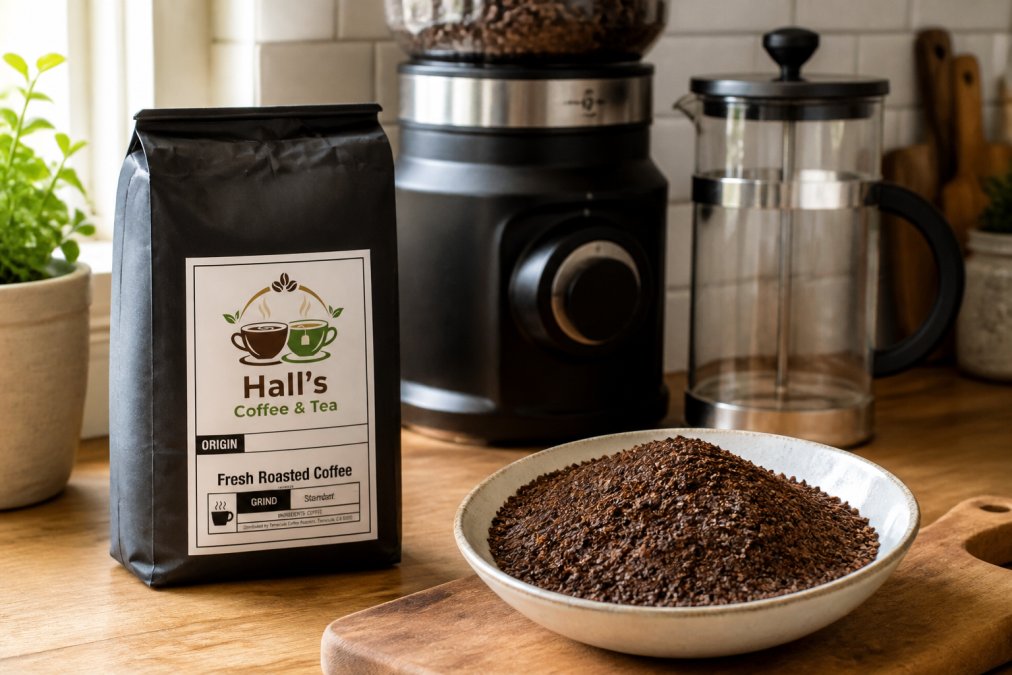
Grind Consistency and Burr Grinders
The biggest mistake most home brewers make is using a blade grinder. Blade grinders chop beans unevenly, producing a mix of fine dust and large chunks. That inconsistency means some particles over-extract while others under-extract, resulting in a bitter, muddy cup.
A burr grinder solves this. Burr grinders crush beans between two abrasive surfaces set at a fixed distance, producing uniform particle size. Consistent particle size means consistent extraction, which translates directly to a cleaner, more defined flavor profile. For French press, set your burr grinder to a coarse setting, the grounds should resemble coarse sea salt, not fine powder.
How Grind Size Affects Extraction and Mouthfeel
Grind size controls how quickly water extracts soluble compounds from the coffee. Finer grinds expose more surface area, speeding up extraction. Coarser grinds slow it down. French press steeps for four minutes, so a coarse grind is calibrated to extract the right balance of sugars, acids, and oils in that window.
Too fine produces bitterness, harsh tannins, and excess sediment. Too coarse produces a weak, sour, watery cup with no body. The sweet spot allows the full four-minute steep without going bitter, with noticeably improved mouthfeel and no gritty sludge.
Best Roast for French Press: Medium vs. Dark Explained
The best roast for French press is either medium or dark, depending on what flavor profile you're chasing.
Medium roast preserves more of the bean's origin character. Fruity acidity, floral notes, and terroir-driven complexity survive a medium roast in ways they don't survive a dark one. In a French press, medium roasts produce a full-bodied cup with brightness and nuance.
Dark roast shifts the flavor equation toward roast character rather than origin character. Sugars caramelize deeply, oils migrate to the bean's surface, and the flavor profile becomes bolder, more bittersweet, and lower in acidity. French press is ideal for dark roasts because the metal filter lets those surface oils pass straight into the cup, amplifying the full-bodied, rich mouthfeel dark roast drinkers expect.
If you want origin-forward complexity, choose medium. If you want bold, low-acid, oil-rich depth, choose dark. Both work exceptionally well in a French press.
French Press Brewing Ratio and Water Temperature
The french press brewing ratio and water temperature are the two variables most home brewers set once and never revisit. Both deserve more attention.
Water-to-Coffee Ratio Calculator
The standard french press brewing ratio is 1:15, one gram of coffee for every 15 grams of water. For a typical 34 oz (1-liter) French press, that works out to roughly 65-67 grams of coffee to 1,000 grams of water.
Use this quick reference:
| French Press Size | Water (grams) | Coffee at 1:15 (grams) | Coffee at 1:12 (stronger) |
|---|---|---|---|
| 12 oz (350 ml) | 350 g | 23 g | 29 g |
| 17 oz (500 ml) | 500 g | 33 g | 42 g |
| 34 oz (1,000 ml) | 1,000 g | 67 g | 83 g |
| 51 oz (1,500 ml) | 1,500 g | 100 g | 125 g |
A 1:15 ratio produces a balanced, full-bodied cup. Drop to 1:12 for a stronger brew. Go above 1:17 and the cup tastes thin.
Water Temperature and Water Chemistry
Water temperature for French press should sit between 195°F and 205°F. Boiling water at 212°F scorches the grounds and over-extracts bitter compounds. Water below 190°F under-extracts and produces a flat, sour cup.
The practical method: bring water to a full boil, then let it rest for 30-45 seconds before pouring. That drops the temperature into the ideal range without needing a thermometer.
Water chemistry matters more than most guides acknowledge. Hard water extracts more aggressively and can push a cup toward bitterness. Soft water under-extracts and produces a thin result. According to the SCAA water quality standards for brewing, ideal brewing water has a total dissolved solids reading between 75-250 ppm with a pH of 6-8.
The Best Coffee Beans for French Press from Hall's
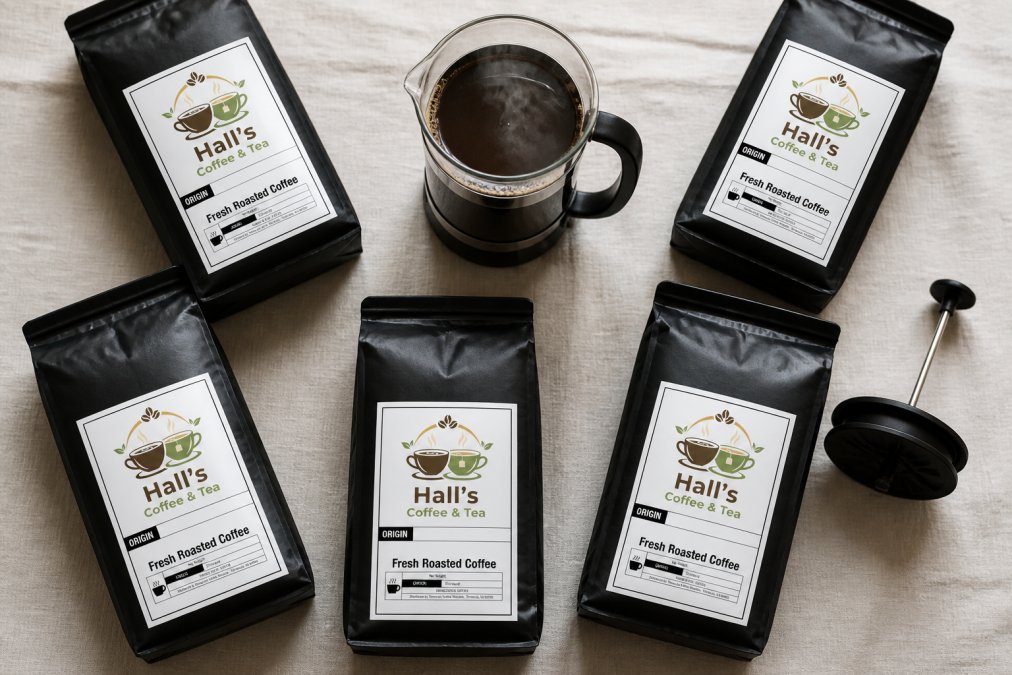
Seven coffees from Hall's Coffee & Tea stand out as genuinely excellent choices for French press brewing.
1. Sumatra, Earthy, Syrupy, Full-Bodied
Roast: Medium | Price: $17.99 | Origin: Aceh, Takengon, Indonesia
Sumatra is the benchmark for French press coffee. The wet-hulling process used in Aceh produces a distinctively syrupy body and earthy depth that immersion brewing amplifies perfectly. Cupping notes include dark chocolate, dried fruit, and a long lingering finish. Medium acidity means the cup sits comfortably without bitterness, even at a 1:12 ratio.

Best for: Drinkers who want maximum body and earthy complexity.
2. Bali Blue, Dark Chocolate and Molasses
Roast: Medium-Dark | Price: $18.99 | Origin: Kintamani, Bali, Indonesia
Grown by smallholder farmers on volcanic loam soil at 1,200-1,600 meters, Bali Blue is hand-picked, wet-hulled, and dried on raised beds. The med-dark roast delivers dark chocolate, molasses, and brown sugar, rich, sweet, and deeply satisfying in a French press.
Best for: Dark chocolate and molasses notes without harsh bitterness.
3. Guatemala, Butterscotch and Bright Fruit
Roast: Medium | Price: $18.99 | Origin: Antigua Guatemala
Guatemala Antigua is one of the most expressive medium roasts for French press. Grown at 1,200-1,616 meters on volcanic loam, it delivers dark chocolate, bright fruit, and butterscotch in a cup that feels both complex and approachable. The brightness cuts through the body in a way that keeps the cup lively rather than heavy.

Best for: Medium roast drinkers who want complexity and a bright finish.
4. Colombia, Dried Orange, Berry, Chocolate
Roast: Medium | Price: $18.99 | Origin: Medellin, Antioquia
Colombian coffee from Medellin is a reliable, well-structured medium roast with tasting notes of dried orange, berry, and chocolate. Grown at 1,300-1,500 meters and fully washed, it produces a clean, fruit-forward cup that translates beautifully to French press.

Best for: Fruit-forward complexity with a clean, structured finish.
5. Peru, Salted Caramel and Citrus
Roast: Medium | Price: $18.99 | Origin: Piura and Amazonas, Peru
Peru delivers salted caramel sweetness, silky body, and a citrus finish. Sourced from the Cooperativa Agricola de Servicios Norandino and grown at 1,100-1,700 meters, this medium roast is smooth and clean.
Best for: Everyday drinkers who want sweetness and smoothness over intensity.
6. French Roast, Bold, Bittersweet, Oil-Sheened
Roast: Dark | Price: $18.99 | Origin: African blend
French Roast is built for this brewing method. A deep dark roast of our highest scoring African coffees, the beans are shiny with visible oil sheen, exactly what you want for French press, where that oil passes directly into the cup. The flavor profile is bold, rich, bittersweet, and low in acidity.
Best for: Bold, low-acid, oil-rich cups for dark roast purists.
7. House Blend, Smooth, Consistent, Crowd-Pleasing
Roast: Medium | Price: $18.99 | Origin: Central and South America blend
The House Blend is the practical answer for households with mixed preferences. A medium roast blend of select Central and South American coffees, it produces a smooth, clean, consistent cup with tasting notes of nutty, sweet chocolate, mild citrus, and a clean bright finish. It's forgiving to brew and works at multiple ratios.
Best for: Households that want a reliable, versatile everyday French press coffee.
Single-Origin vs. Blend: Which Works Better in a French Press?
Single-origin coffee and blends each have a legitimate place in French press brewing.
Single-origin coffees express the character of one specific place: the soil, altitude, processing method, and varietal all show up in the cup. French press is ideal for single-origin exploration because the oil retention and full extraction amplify terroir-driven notes. Sumatra's earthiness, Guatemala's bright fruit, Peru's salted caramel, these are real, distinct flavor experiences that immersion brewing delivers more faithfully than filtered methods.
Blends solve for consistency. The House Blend and French Roast are formulated to taste the same cup after cup, season after season. For daily drinkers who want a predictable result without adjusting expectations, blends are the smarter choice.
If you're curious about coffee and enjoy exploring flavor, start with single-origins. If you want a dependable morning cup without analysis, a well-crafted blend delivers every time.
Decaf, Low-Acid Options, and Storing Your Beans
French press doesn't require caffeine to deliver a great cup. Many decaf options use Swiss Water Process decaffeination, which removes caffeine without chemical solvents and preserves flavor. For decaf French press, medium and medium-dark roasts perform best.
Low-acid options are worth considering for anyone sensitive to coffee's natural acidity. Sumatra is naturally lower in acidity than most origins, making it the default recommendation for acid-sensitive drinkers. Dark roasts are also lower in acidity than medium roasts, as the roasting process converts chlorogenic acids into less acidic compounds. French Roast specifically is low-acid, making it practical for those who enjoy bold coffee without stomach discomfort.
Storing your beans correctly:
- Store in an airtight container away from light, heat, and moisture
- Avoid the refrigerator; condensation degrades flavor
- Buy in quantities you'll use within two to three weeks of roasting
- Freeze only if storing for more than a month, in airtight bags with minimal air
According to the National Coffee Association's home brewing guide, improper storage is the leading cause of premature flavor degradation in home coffee.
Which Coffee Should You Pick for Your French Press?
The right coffee beans for French press depend on three things: roast preference, flavor direction, and how you drink it.
| Coffee | Roast | Tasting Notes | Best For |
|---|---|---|---|
| Sumatra | Medium | Earthy, dark chocolate, syrupy | Maximum body, everyday drinker |
| Bali Blue | Med-Dark | Dark chocolate, molasses, brown sugar | Dark chocolate lovers |
| Guatemala | Medium | Butterscotch, bright fruit, chocolate | Complexity and brightness |
| Colombia | Medium | Dried orange, berry, chocolate | Fruit-forward, clean finish |
| Peru | Medium | Salted caramel, silky, citrus | Sweetness and smoothness |
| French Roast | Dark | Bold, bittersweet, low-acid | Dark roast purists |
| House Blend | Medium | Nutty, sweet chocolate, mild citrus | Consistency, mixed households |
If you're starting from scratch: Sumatra is the most French press-native bean on the list. If you want something more fruit-forward: Guatemala or Colombia. If you want bold and low-acid: French Roast.
The common thread across all of them is that they're sourced with care, roasted to a level that performs in immersion brewing, and available fresh. That last point matters more than any single flavor descriptor.
Frequently Asked Questions
Does grind size really matter when choosing coffee beans for a French press?
Grind size is one of the most important variables in French press brewing. A coarse grind slows extraction during the 4-minute steep, which reduces bitterness and keeps sediment out of your cup. Fine or medium grinds over-extract quickly, producing a harsh, muddy result. Using a burr grinder gives you consistent particle size, which means more even extraction and a cleaner, full-bodied mouthfeel every time you brew.
What is the best roast level for French press coffee?
Medium and medium-dark roasts are the most reliable choices for French press. They preserve origin flavor notes, chocolate, fruit, caramel, while still producing the full body that immersion brewing is known for. Dark roasts like a French Roast work well if you prefer bold, bittersweet flavor with low acidity. Light roasts can taste thin or sour in a French press because the method amplifies acidity without enough body to balance it.
Should I use pre-ground or whole bean coffee for a French press?
Whole bean coffee brewed fresh is the better choice. Ground coffee begins losing aroma and flavor within 15-30 minutes of grinding as CO2 escapes. For French press, you want that freshness to survive the full 4-minute steep. Buy whole beans and grind them just before brewing. If you must use pre-ground coffee, buy it in small quantities and store it in an airtight container away from light and heat to slow staleness.
Are single-origin beans better than blends for French press?
Neither is objectively better, they serve different goals. Single-origin beans from places like Sumatra, Colombia, or Guatemala showcase distinct tasting notes and regional character, which the immersion brewing method amplifies beautifully. Blends are crafted for consistency and balance, making them a reliable daily driver. If you enjoy exploring flavor profiles and origin stories, single-origin is rewarding. If you want a smooth, predictable cup every morning, a well-made blend delivers that dependably.
What is the correct French press brewing ratio?
A standard starting ratio is 1:15, 1 gram of coffee for every 15 grams (about 15 ml) of water. For a 32-ounce French press, that works out to roughly 60 grams of coffee to 900 ml of water. If you prefer a stronger, more concentrated cup, move to 1:12. Brew time stays at 4 minutes regardless of ratio. Adjust the ratio rather than the steep time to control strength, since longer steeping increases bitterness rather than body.
Finding great coffee beans for French press shouldn't require a deep research project every time you run low. Hall's Coffee & Tea offers free US shipping on premium single-origin and blended selections, all sourced from growers who treat coffee as a craft rather than a commodity. Whether you're drawn to Sumatra's syrupy depth or Guatemala's bright complexity, the right beans are already waiting. Shop Coffee at Hall's Coffee & Tea and find your next favorite cup.
This article was written using GrandRanker
