

Best Coffee Beans for Home Brewing: 2026 Guide
Table of Contents
- How to Choose the Best Coffee Beans for Home Brewing
- Coffee Roast Levels Explained
- Origin Characteristics and Flavor Profiles to Know
- Best Grind Size for Different Brewing Methods
- How to Store Coffee Beans for Freshness
- Water Chemistry, Budget, and Buying Smart
- Top Coffee Beans for Home Brewing Worth Trying
- Conclusion
Last Updated: August 19, 2026
How to Choose the Best Coffee Beans for Home Brewing
Most people buying coffee beans pick based on packaging, not how they actually brew. Roast level, origin, and processing method all interact with your equipment in ways that dramatically change what ends up in your cup. At Hall's Coffee & Tea, we offer a premium selection of single-origin beans and blends. Below, we'll walk through exactly how to match beans to your setup, your palate, and your budget, including two angles most buying guides skip: water chemistry and the subscription-versus-grocery-store question.
Quick Picks:
- Best for flavor exploration: Single-origin light roasts from Ethiopia or Colombia
- Best everyday cup: Medium roast blends with balanced body and sweetness
- Best for espresso at home: Medium-dark single-origin or purpose-built espresso blends
- Best for cold brew: Dark roast or natural-process beans with chocolatey, low-acid notes
Single-Origin vs. Blended Beans
Single-origin coffee reflects the specific soil, altitude, and climate where those beans grew. Blends combine beans from multiple origins to achieve consistency and balance.
Neither is objectively better. Single-origin beans reward curiosity: a washed Ethiopian Yirgacheffe tastes strikingly different from a natural-process Guatemalan. Blends are engineered for reliability, if you want the same chocolatey, caramel-forward cup every morning, a well-crafted blend delivers that. For most home brewers: start with a medium-roast blend to calibrate your palate, then branch into single-origin once you understand what you're tasting.
Whole Bean vs. Pre-Ground: Which Wins at Home?
Whole bean coffee wins decisively. Once ground, coffee loses volatile aromatic compounds within minutes. Whole bean only matters if you're grinding fresh, right before brewing. A burr grinder produces consistent particle sizes that extract evenly, directly affecting sweetness, acidity, and body.
Coffee Roast Levels Explained
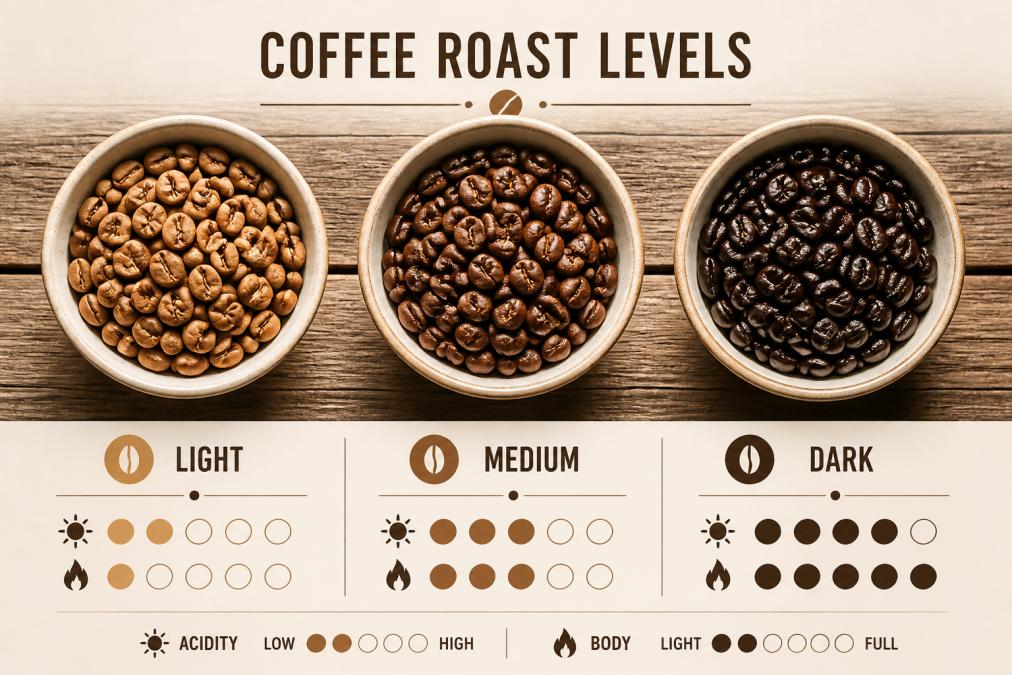
Roast level fundamentally shapes flavor, acidity, and how forgiving the bean is to extraction errors. It does not determine caffeine content meaningfully.
Light Roast: Bright, Floral, and Fruity
Light roast stops before the first crack fully develops, retaining most of its origin character: floral tasting notes, citrusy acidity, and complex fruit-forward sweetness. These beans suit pour over and drip brewing best, where slower extraction pulls out nuance. Water temperature between 200°F and 205°F and a medium-fine grind will reward you with remarkable flavor complexity unavailable in darker roasts.
Medium Roast: Balanced and Approachable
Medium roast is the sweet spot for most home brewers. The bean develops enough to mellow sharp acidity while preserving sweetness and some origin character. Tasting notes run toward caramel, toasted nut, milk chocolate, and stone fruit. Medium roasts work across nearly every brewing method and are more forgiving of minor grind inconsistencies and water temperature variation.
Dark Roast: Bold, Chocolatey, and Low-Acid
Dark roast beans are taken past the second crack, driving off most acidity and much of the origin character. What remains is the roast character itself: dark chocolate, bittersweet caramel, and a heavy, syrupy body with low acidity. For cold brew, dark roasts are genuinely the best choice: the long steeping process extracts deeply, and the low acidity prevents sharpness that can develop over 12-24 hours of brewing.
Origin Characteristics and Flavor Profiles to Know
Where a coffee is grown shapes its flavor at least as much as how it's roasted. Altitude, soil composition, rainfall patterns, and processing method all leave their mark on the final cup.
| Origin | Flavor Profile | Acidity | Body | Best Brewing Method |
|---|---|---|---|---|
| Ethiopia | Floral, blueberry, citrusy | High | Light | Pour over |
| Colombia | Caramel, red fruit, balanced | Medium | Medium | Drip, pour over |
| Guatemala | Dark chocolate, toasted nut | Medium-low | Full | Espresso, French press |
| Brazil | Nutty, chocolatey, low-acid | Low | Heavy | Espresso, cold brew |
| Kenya | Blackcurrant, tomato, bright | High | Medium-full | Pour over |
| Sumatra | Earthy, cedar, herbal | Low | Very full | French press |
Washed-process coffees tend to be cleaner and brighter, with acidity and floral notes front and center. Natural-process beans dry inside the coffee cherry, imparting fruit-forward sweetness and heavier mouthfeel. Honey-process sits between the two, offering sweetness with more clarity than a full natural.
Best Grind Size for Different Brewing Methods
Grind size controls extraction rate. Too fine, and water over-extracts bitter compounds. Too coarse, and water rushes through before pulling out sweetness and complexity.
Pour Over and Drip Coffee
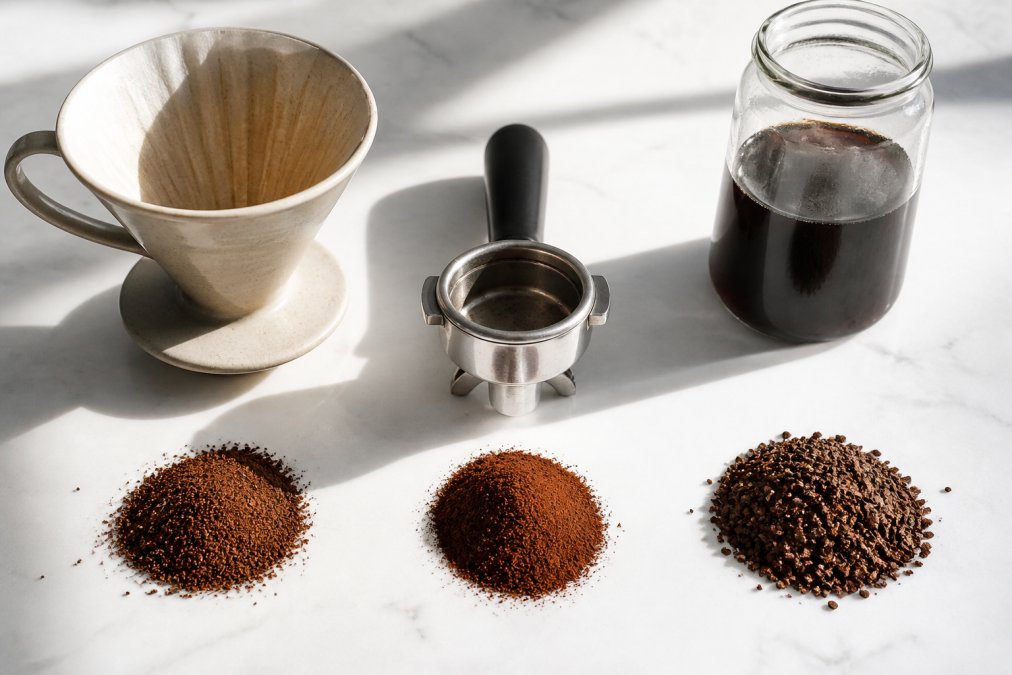
Pour over brewing calls for a medium-fine grind, roughly the texture of table salt. This allows water to pass through in 3-4 minutes, the window where most desirable compounds extract without tipping into bitterness. Blooming, the initial 30-45 second pour that allows CO2 to escape, matters here too.
Espresso and Cold Brew
Espresso requires a fine grind, close to powdered sugar texture. The high pressure of an espresso machine forces water through tightly packed grounds in 25-30 seconds, and grind size is the primary variable you control for extraction.
Cold brew sits at the opposite end: use a coarse grind, similar to coarse sea salt. The long steep time (12-24 hours) compensates for the coarse grind, and a finer grind will produce an over-extracted, astringent result.
How to Store Coffee Beans for Freshness
Proper storage is one of the most overlooked factors in home brewing quality. Freshly roasted coffee begins degassing immediately, and exposure to air, light, heat, and moisture accelerates staling.
The best way to store coffee beans follows these clear rules:
- Use an airtight container with a one-way valve if possible. One-way valves let CO2 escape without letting oxygen in.
- Keep beans at room temperature, away from heat sources. The refrigerator introduces moisture; the freezer is acceptable for long-term storage of unopened bags only.
- Store away from direct light. Opaque containers beat clear glass jars.
- Buy in smaller quantities more frequently. A 250g bag consumed within two weeks tastes better than a 1kg bag that sits open for a month.
- Check the roast date, not the "best by" date. Most specialty roasters recommend brewing within 2-6 weeks of the roast date for peak flavor.
Water Chemistry, Budget, and Buying Smart
The bean matters, but the water you brew with matters almost as much, and the channel through which you buy affects freshness more than most people account for.
Water Quality and Its Effect on Extraction
Water chemistry directly affects extraction. The mineral content determines how efficiently it pulls soluble compounds from the grounds. Total dissolved solids (TDS) is the key metric. Water that's too pure lacks the minerals needed to carry flavor compounds effectively. Water that's too mineral-heavy can suppress acidity and produce a flat, chalky cup. The Specialty Coffee Association's water quality standards recommend water with a TDS between 75 and 250 parts per million, with a target of around 150 ppm for optimal extraction. If your tap water tastes fine on its own, it will probably produce decent coffee. If it tastes strongly of chlorine or has visible mineral deposits in your kettle, filtered water is worth the switch.
Subscription vs. Grocery Store Buying
Grocery store coffee has one fundamental problem: you rarely know when it was roasted. Retail supply chains mean beans sit in warehouses for weeks before reaching the shelf, then sit on the shelf for weeks more.
Specialty coffee subscriptions solve the freshness problem by shipping directly from the roaster, often within days of roasting. The roast date is printed on the bag, and the beans arrive in the optimal 4-14 day post-roast window. The tradeoff is commitment. Try a few single-purchase bags from a specialty roaster first to identify your preferences, then commit to a subscription for your favorites.
Hall's Coffee & Tea ships premium single-origin beans and carefully crafted blends directly to your door, with roast dates clearly marked so you always know what you're getting. Free US shipping removes the cost friction that often pushes buyers toward inferior grocery-store options.
Top Coffee Beans for Home Brewing Worth Trying
The best coffee beans for home brewing depend on your method, your palate, and your tolerance for experimentation.
| Brewing Style | Recommended Origin | Roast Level | Processing | Flavor to Expect |
|---|---|---|---|---|
| Pour over | Ethiopia | Light | Washed | Floral, blueberry, citrus |
| Drip coffee | Colombia | Medium | Washed | Caramel, red apple, balanced |
| Espresso | Guatemala or Brazil | Medium-dark | Washed or natural | Dark chocolate, toasted nut |
| Cold brew | Brazil or Sumatra | Dark | Natural | Chocolatey, low-acid, smooth |
| French press | Sumatra or Guatemala | Medium-dark | Wet-hulled | Earthy, full body, herbal |
1. Hall's Coffee & Tea Single-Origin Selections, Best Overall for Home Brewers
Hall's Coffee & Tea offers a premium selection of single-origin beans and carefully crafted blends. The single-origin lineup covers a range of origins and roast levels, with tasting notes and roast dates clearly communicated so you can match the bean to your method before you buy. Hall's Coffee & Tea sources high-quality ingredients with passion and care. Free US shipping means the premium goes into the bean, not the logistics.
Best for: Home brewers at any level who want freshness, variety, and selection that rewards curiosity.
2. Ethiopian Light Roast (Washed Process), Best for Pour Over
A washed Ethiopian is the most instructive bean for anyone learning to taste specialty coffee. The flavor profile, floral aroma, bright citrusy acidity, blueberry-like sweetness, is distinctive enough that it trains your palate to recognize what origin character actually tastes like. Brew it as a pour over at 202°F with a medium-fine grind and a 45-second bloom.
3. Colombian Medium Roast, Best for Everyday Drip
A balanced Colombian medium roast is the most versatile bean for home brewing. The flavor profile (caramel sweetness, mild red-fruit acidity, medium body) works across drip machines, pour overs, and French press. It's forgiving enough for beginners and interesting enough that experienced brewers don't get bored with it.
4. Brazilian Natural Dark Roast, Best for Cold Brew
Brazil produces some of the most cold-brew-friendly beans available. Natural processing concentrates the sweetness of the coffee cherry into the bean, producing chocolatey, low-acid notes that hold up beautifully over a 16-hour cold steep. Grind coarse, use a 1:8 coffee-to-water ratio, and steep cold for 14-18 hours.
5. Guatemalan Medium-Dark, Best for Home Espresso
Guatemala's high-altitude growing regions produce beans with dense structure built for espresso: dark chocolate, toasted nut, and a syrupy body with just enough acidity to keep the shot lively. A medium-dark roast from Huehuetenango or Antigua pulls shots with thick crema and a long, pleasant aftertaste.
Last Updated: August 19, 2026
Choosing the right coffee beans for home brewing is more interesting than most guides make it sound, but it doesn't have to be overwhelming. Start with your brewing method, match the roast level and origin to what that method does well, and prioritize freshness above everything else. Hall's Coffee & Tea makes that process straightforward: expertly sourced single-origin beans and blends, shipped fresh with roast dates clearly marked, and delivered free across the US. Shop Coffee at Hall's Coffee & Tea and find the cup you've been looking for.
Frequently Asked Questions
What are the most important factors when choosing coffee beans for home brewing?
Roast level, origin, freshness, and brewing method compatibility matter most. A light roast Ethiopian single-origin suits pour over beautifully, while a darker roast from Latin America works better for espresso. Check the roast date on the bag, beans are at their best within two to four weeks of roasting. Processing method (washed vs. natural) also shapes flavor profile significantly, so it's worth reading tasting notes before you commit to a bag.
How does roast level affect the flavor of home-brewed coffee?
Light roasts preserve the natural characteristics of the coffee cherry, producing bright acidity, floral aromas, and citrusy or fruity tasting notes. Medium roasts balance acidity with body, offering caramel and toasted nut sweetness. Dark roasts develop bitterness and chocolatey depth while reducing acidity and caffeine content slightly. The roast level you choose should match both your taste preferences and your brewing equipment, since extraction behaves differently across roast levels.
What is the difference between single-origin and blended coffee beans?
Single-origin beans come from one farm, region, or country, which makes their flavor profile distinct and traceable. They're ideal for home baristas who want to explore how origin, altitude, and processing method shape the cup. Blended beans combine multiple origins to create a consistent, balanced flavor year-round, a reliable choice for everyday drip coffee or espresso. Neither is objectively better; the right pick depends on whether you prioritize exploration or consistency in your morning cup.
How should I store coffee beans at home to maintain freshness?
Keep whole beans in an airtight, opaque container away from heat, light, and moisture. A ceramic canister with a one-way valve works well. Store at room temperature, the freezer introduces moisture during thawing cycles, which damages flavor. Buy in quantities you'll use within two to three weeks of the roast date. Grinding just before brewing preserves aroma and slows oxidation, so a burr grinder is worth the investment if freshness matters to you.
Does my brewing method change which coffee beans I should buy?
Yes, noticeably. Pour over and drip coffee highlight the nuanced acidity and aroma of light to medium roasts, making single-origin specialty coffee a natural fit. Espresso machines extract at high pressure, so medium-dark to dark roasts with lower acidity and higher solubility perform more consistently. Cold brew benefits from coarse-ground dark or medium-dark roasts, which produce a smooth, low-bitterness concentrate. Matching your beans to your brewing method is one of the fastest ways to improve your cup.
This article was written using GrandRanker
