

Best Way to Brew Loose Leaf Tea: A Complete Guide
Table of Contents
- What You'll Need to Brew Loose Leaf Tea
- Loose Leaf Tea Brewing Ratio: How Much Tea Per Cup
- Best Water Temperature for Tea Types
- Steeping Times for Green vs Black Tea (and Every Type Between)
- Step-by-Step: The Best Way to Brew Loose Leaf Tea
- How to Brew Tea Without an Infuser
- Troubleshooting Bitter or Weak Tea
- Cold Brewing, Cleaning, and Sustainability Tips
Last Updated: August 19, 2026
Most guides on how to brew loose leaf tea give you a list of steps and call it done. What they skip is why temperature, ratio, and steep time interact the way they do, and what to do when your cup tastes wrong. The best way to brew loose leaf tea is not a single method, it's a set of principles you apply differently depending on the tea in your cup.
Below, you'll find specific temperature charts, a ratio guide, step-by-step instructions, and fixes for common problems. Whether you're brewing your first pot of green tea or trying to get more out of a high-grade oolong, this is the guide to keep open.
What You'll Need to Brew Loose Leaf Tea
A good brewing setup has three components: something to heat water, something to steep the leaves in, and something to strain them out. That's it.
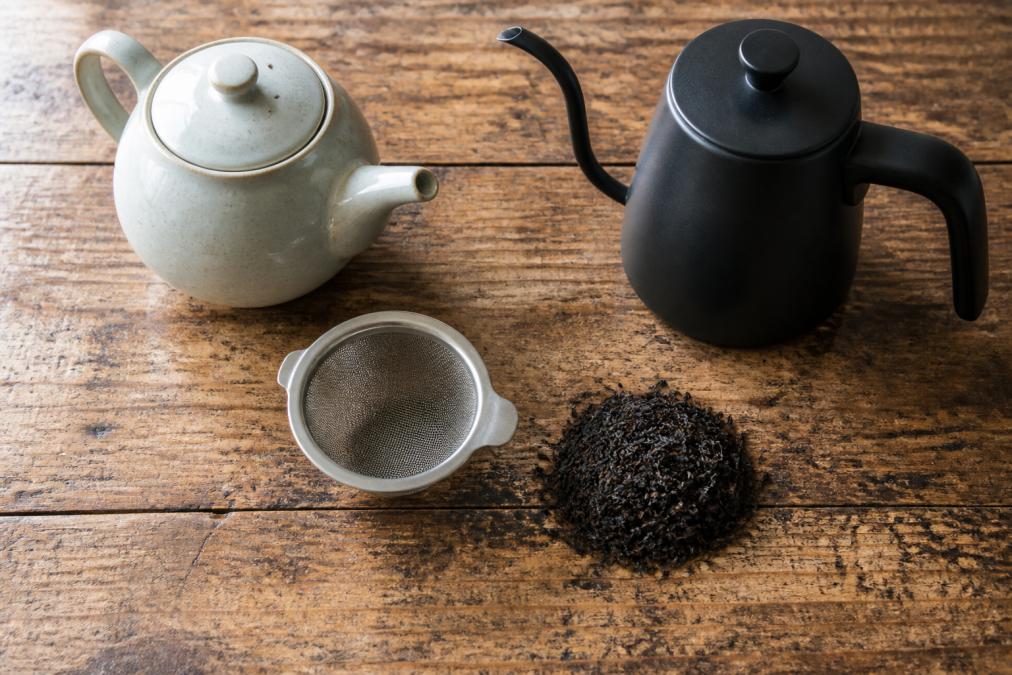
Types of Tea Infusers and Strainers
The infuser you choose directly affects extraction. Leaf expansion is key: tea leaves need room to unfurl fully as they steep.
| Infuser Type | Best For | Leaf Room | Notes |
|---|---|---|---|
| Mesh ball infuser | Everyday convenience | Limited | Works for broken-leaf teas; restricts whole-leaf expansion |
| Basket infuser | Most tea types | Good | Fits inside mugs or teapots; best all-around choice |
| French press | Larger volumes | Excellent | Great for full-leaf teas; requires careful straining |
| Gaiwan | Oolong, white, green | Excellent | Traditional; allows full leaf expansion and multiple steeps |
| Over-cup strainer | Any loose leaf | Excellent | Simple, no basket needed; pour through directly |
For whole-leaf teas like high-grade oolongs or white teas, a basket infuser or gaiwan is best. Mesh balls work fine for CTC (crush-tear-curl) black teas and herbal blends.
Choosing the Right Water: Filtration and TDS
Water quality is the most underrated variable in tea brewing. Tea is roughly 99% water, so what's in that water ends up in your cup.
TDS (Total Dissolved Solids) measures dissolved minerals in water. The ideal TDS range for tea is between 50 and 150 parts per million (ppm). Too low, and the water tastes flat and fails to extract flavor fully. Too high, and minerals compete with the tea's natural compounds, producing a dull or chalky cup.
Hard tap water suppresses aroma and makes tannins taste harsh. Distilled water produces a flat, lifeless brew. Filtered water, whether through a pitcher filter or an under-sink system, typically hits the right balance. According to the EPA's guidance on drinking water quality, municipal tap water TDS varies widely by region, which is why filtered water produces more consistent results.
Always use freshly drawn water. Water that has been sitting or reboiled loses dissolved oxygen, which dulls flavor and aroma.
Loose Leaf Tea Brewing Ratio: How Much Tea Per Cup
The standard loose leaf tea brewing ratio is one teaspoon of tea per six to eight ounces of water. However, the real answer depends on tea grade and leaf density. Measuring by weight is more accurate than measuring by volume.
A practical framework:
- Black tea: 2 to 3 grams per 8 oz
- Green tea: 2 grams per 8 oz
- White tea: 2 to 3 grams per 8 oz
- Oolong: 3 to 5 grams per 8 oz
- Herbal/tisane: 1 heaping teaspoon per 8 oz
- Pu-erh: 3 to 5 grams per 8 oz
A common mistake is using too little tea and over-steeping to compensate. That's a fast route to astringency. Use the right amount of leaf, and you get full flavor without bitterness.
Best Water Temperature for Tea Types
Water temperature is the single variable most people get wrong. Boiling water at 212°F is only correct for black tea and most herbals. Green tea is extremely sensitive to heat; boiling water scalds the leaves, releasing excess tannins and producing a bitter, vegetal cup. According to research on tea polyphenols and brewing chemistry, higher temperatures extract tannins and catechins more aggressively.
| Tea Type | Ideal Water Temperature | Notes |
|---|---|---|
| White tea | 160-175°F | Delicate; lower heat preserves sweetness |
| Green tea | 170-185°F | Never boiling; watch for bitterness |
| Yellow tea | 175-185°F | Similar to green |
| Oolong (light) | 185-195°F | Closer to green end of spectrum |
| Oolong (dark) | 195-205°F | More oxidized; handles more heat |
| Black tea | 200-212°F | Full boil is fine |
| Pu-erh | 205-212°F | Aged pu-erh benefits from near-boiling water |
| Herbal/tisane | 208-212°F | Most need a full boil to extract properly |
If you don't have a variable-temperature kettle, bring water to a boil and let it cool for the appropriate time: roughly two minutes for green tea temperatures, one minute for oolong.
Steeping Times for Green vs Black Tea (and Every Type Between)
Steeping time determines how much of the tea's compounds make it into your cup. Steep too short and the tea tastes thin. Steep too long and tannins dominate, producing bitterness.
| Tea Type | First Steep | Notes |
|---|---|---|
| White tea | 2-5 minutes | Longer steeps are fine; white tea is forgiving |
| Green tea | 1-3 minutes | Short steep, lower temp; multiple steeps possible |
| Yellow tea | 1-2 minutes | Treat similarly to green |
| Light oolong | 2-3 minutes | Can be re-steeped 3-5 times |
| Dark oolong | 3-5 minutes | Richer extraction; handles longer steeps |
| Black tea | 3-5 minutes | Strong flavor; adjust to taste |
| Pu-erh (raw) | 1-3 minutes | Multiple steeps; each develops differently |
| Pu-erh (aged) | 3-5 minutes | Earthy, full-bodied |
| Herbal/tisane | 5-10 minutes | Most need extended time to fully extract |
High-quality loose leaf teas are designed for multiple steeps. A good oolong or pu-erh will give you three to five distinct infusions, each with a slightly different flavor profile. The second steep is often the best one.
Step-by-Step: The Best Way to Brew Loose Leaf Tea
The best way to brew loose leaf tea follows a consistent sequence: heat water to the right temperature, measure your tea, pre-warm your vessel, steep for the correct time, and strain completely.
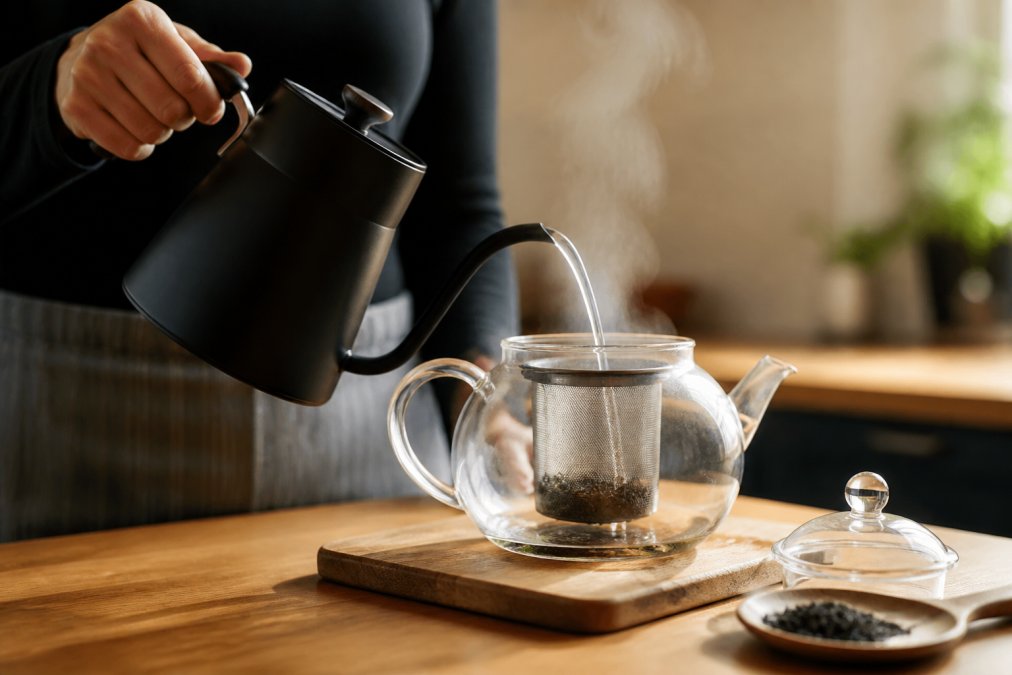
- Heat fresh water to the target temperature for your tea type. Use filtered water for the best results.
- Pre-warm your brewing vessel by rinsing it with a splash of hot water. This keeps the brewing temperature stable.
- Measure your tea using the ratio guide above. Add it to your infuser or directly to the vessel if using a strainer.
- Pour water over the leaves, not the other way around. This distributes heat evenly and helps circulate the leaves for better extraction.
- Start your timer immediately. Use the steeping times listed above.
- Remove the infuser or strain completely when the time is up. Leaving leaves in the water after steeping is the most common cause of bitterness.
- Taste and adjust. If the tea is too strong, use less leaf or shorten the steep next time. If it's too weak, increase the ratio.
Leaf Expansion and Why It Changes Everything
Leaf expansion is the mechanism through which flavor compounds, caffeine, and antioxidants move from the leaf into the water. Whole-leaf teas can expand to three or four times their dry size. When leaves are crowded into a small infuser, they can't fully open, and extraction stays shallow.
Give the leaves room to circulate freely, and the flavor profile opens up dramatically.
How to Brew Tea Without an Infuser
You don't need an infuser to brew loose leaf tea. Several methods work well without one.
The French press method is the most practical. Add your measured tea directly to the French press, pour heated water over it, and steep for the appropriate time. When done, press the plunger slowly and pour immediately. This method gives leaves maximum room to expand and works especially well for black teas and herbals.
The over-cup strainer method uses a fine mesh strainer held over your cup. Steep the leaves in a small bowl or pot, then strain directly into your cup as you pour.
The cold brew method (covered in the next section) requires no infuser at all. Just combine leaves and cold water in a jar and refrigerate.
The pot-and-strain method is how tea was brewed historically. Steep leaves directly in a teapot or saucepan, then pour through a strainer into your cup.
Troubleshooting Bitter or Weak Tea
Bitter tea and weak tea are the two most common problems, and both have clear causes.
If your tea tastes bitter:
- Water temperature was too high, especially for green or white tea
- Steep time was too long
- Too much leaf relative to water volume
- Water TDS is very high; try filtered water
If your tea tastes weak or watery:
- Not enough leaf; increase the ratio
- Water temperature was too low to extract properly
- Steep time was too short
- The tea grade is low or the leaves are stale
Change one variable at a time. If your green tea is bitter, drop the temperature before you shorten the steep. Astringency, that dry, mouth-coating sensation, is a sign of excess tannin extraction. Lower temperature and shorter steep time address both. According to Penn State Extension's overview of tea chemistry, the balance between catechins, tannins, and amino acids in brewed tea is directly affected by water temperature and contact time.
Cold Brewing, Cleaning, and Sustainability Tips
Cold brewing produces a noticeably different result from hot brewing. The lower temperature extracts flavor compounds slowly over several hours, pulling out sweetness and caffeine while leaving most bitter tannins behind. The result is a smooth, naturally sweet tea.
To cold brew loose leaf tea:
- Use roughly double the leaf ratio you'd use for hot brewing.
- Combine leaves and cold filtered water in a jar or pitcher.
- Refrigerate for 6 to 12 hours.
- Strain and drink within 48 hours.
Green tea and white tea cold brew exceptionally well.
Cleaning your equipment matters more than most people realize. Tannin buildup on infusers and teapots affects future brews. Rinse all equipment with hot water immediately after use. For stubborn staining, soak in warm water and baking soda to remove tannin deposits without leaving chemical residue.
Sustainability note: Spent tea leaves are fully compostable and add nitrogen to compost piles. They can be used directly as a light soil amendment for acid-loving plants. High-quality loose leaf tea can be steeped multiple times before composting, which reduces waste further.
Loose leaf tea, brewed with attention and the right technique, produces a better cup than bagged tea in almost every measurable way: more complex flavor, better aroma, and more control over the final result.
Frequently Asked Questions
How much loose leaf tea should I use per cup of water?
A standard starting point is 1 teaspoon of loose leaf tea per 8 ounces of water, though this varies by tea type. Dense, small-leaf teas like Assam black tea pack more tightly, so a level teaspoon goes further. Larger, fluffy leaves like white or oolong teas need closer to 1.5-2 teaspoons per cup because they take up more volume before they expand. Adjust from there based on your personal taste preference and the specific tea grade you're brewing.
Can you steep loose leaf tea for too long?
Yes. Steeping too long releases excess tannins, which create bitterness and sharp astringency. Green teas are the most sensitive, even 30 extra seconds past the recommended time can make a cup taste harsh. Black teas are more forgiving but still turn bitter beyond 5 minutes. If you want a stronger cup, use more tea leaves rather than extending the steeping time. Remove the infuser or strain the leaves as soon as the steep is complete.
Does water temperature affect the taste of loose leaf tea?
Water temperature is one of the biggest factors in flavor. Boiling water (212°F) scorches delicate green and white tea leaves, pulling out bitter compounds before the tea's natural sweetness and aroma have a chance to develop. Black and herbal teas handle full boiling temperatures well. Using water that's too cool, on the other hand, under-extracts the leaves, leaving the brew flat and weak. Matching temperature to tea type is as important as getting the steeping time right.
Can I brew loose leaf tea without an infuser?
Absolutely. The simplest method is to steep the leaves directly in your mug or a French press, then pour through a fine-mesh kitchen strainer into a second cup. A French press works especially well because it gives leaves room to expand fully and is easy to press and pour. You can also fold a small square of cheesecloth into a pouch and tie it off. None of these methods require specialty equipment, and the results are just as good as using a dedicated tea infuser.
Brewing great loose leaf tea comes down to controlling a few variables consistently: water quality, temperature, ratio, and steep time. Hall's Coffee & Tea carries a curated selection of premium loose leaf teas sourced for quality and flavor complexity, delivered directly to your door with free US shipping. Explore the collection and find a tea worth brewing with care.
This article was written using GrandRanker
