

Benefits of Artisanal Loose Leaf Tea: A 2026 Guide
Table of Contents
- Why Artisanal Loose Leaf Tea Tastes Better Than Bagged Tea
- Loose Leaf Tea vs Tea Bags: What Actually Changes in Your Cup
- The Best Way to Brew Loose Leaf Tea at Home
- Steeping Time for Loose Leaf Tea: A Practical Guide
- Antioxidants, Catechins, and What Loose Leaf Tea Does for Your Body
- Multiple Steeps, Storage, and Preserving Essential Oils
- Terroir, Harvest Season, and Why Origin Changes Everything
- Sustainability, Cost, and the Real Value of Artisanal Tea
- Frequently Asked Questions
Last Updated: September 14, 2026
Why Artisanal Loose Leaf Tea Tastes Better Than Bagged Tea
The difference between artisanal loose leaf tea and a supermarket bag comes down to leaf integrity. Bagged tea typically contains fannings and dust, broken fragments left after whole leaves are sorted for premium sale, which stale faster and release flavor unevenly.
Artisanal loose leaf tea is the whole, unbroken leaf, handled so its essential oils stay intact until brewing, driving aroma, mouthfeel, and how many times you can steep it.
This guide from Hall's Coffee & Tea covers what changes in your cup, how to brew loose leaf properly, and why origin and harvest matter.
Loose Leaf Tea vs Tea Bags: What Actually Changes in Your Cup
Whole leaves unfurl slowly, releasing flavor in layers; fannings and dust release everything at once, which is why a bagged cup often turns bitter within two minutes. There's a second issue most guides skip: the bag itself.
The Microplastics Problem in Conventional Tea Bags
Many conventional tea bags are sealed with food-grade plastic, and some "silken" bags use petroleum-based nylon or PET. Research has found that steeping a single plastic tea bag at brewing temperature can release substantial numbers of micro- and nanoplastic particles into the water (pubmed.ncbi.nlm.nih.gov). Long-term health implications are still being studied, but the mechanism is documented.
Loose leaf tea sidesteps the problem. There's no plastic seal, no synthetic mesh, just leaf and water.
Whole Leaf vs Fannings and Dust
| Grade | What It Is | Flavor Release | Steeps |
|---|---|---|---|
| Whole leaf | Intact leaves, hand-sorted | Slow, layered | 3-5+ |
| Broken leaf | Cut whole leaves | Medium | 2-3 |
| Fannings | Small fragments | Fast, flat | 1-2 |
| Dust | Powder-fine particles | Immediate, bitter | 1 |
Whole leaf wins on every column that matters for a cup you actually want to drink slowly.
The Best Way to Brew Loose Leaf Tea at Home
The best way to brew loose leaf tea at home is simpler than equipment lists suggest: measure your leaf, heat your water correctly, and time the steep.
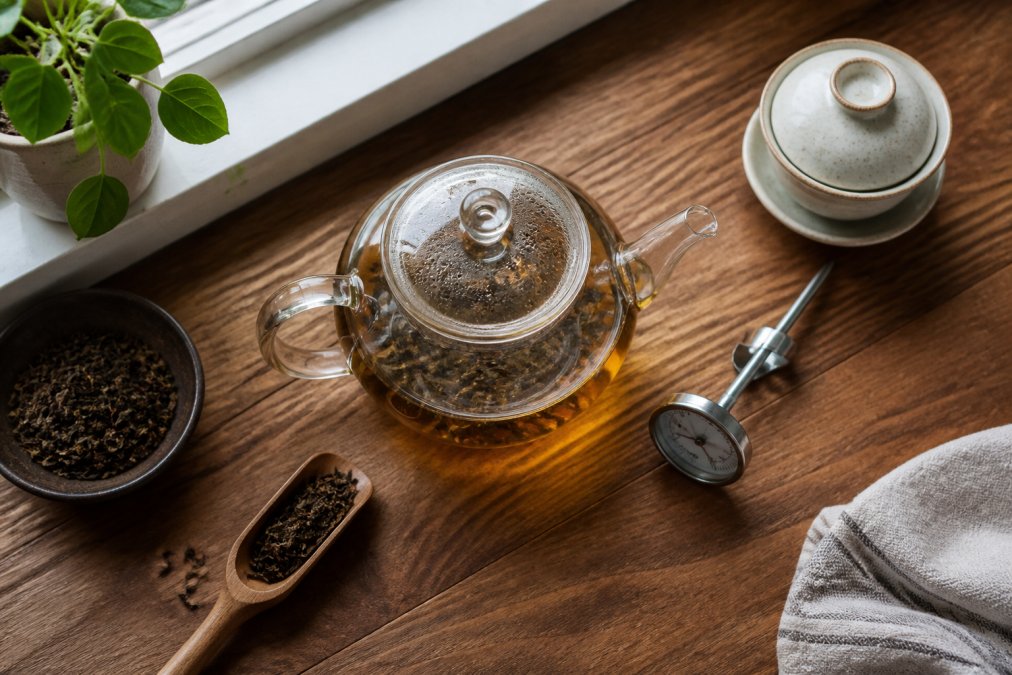
Start with roughly one teaspoon of leaf per 8 ounces of water. Green and white teas want cooler water; black and oolong handle near-boiling temperatures without turning harsh.
Water Temperature and Chemistry Matter More Than You Think
Water quality is the variable most home brewers ignore. Heavily mineralized tap water flattens a delicate green tea; water that's too soft makes it taste thin.
A practical starting point:
- Green tea: 160-175°F
- White tea: 175-185°F
- Oolong: 185-195°F
- Black tea: 200-212°F
If your tap water tastes strongly of chlorine or minerals, filtered water will noticeably improve the cup.
Brewing Vessels: Gaiwan, Strainer, or Teapot
A gaiwan gives the most control and suits multiple steeps. A strainer over a mug works fine for beginners. A teapot suits brewing for two or more. None are mandatory, a strainer and thermometer get you most of the way.
Steeping Time for Loose Leaf Tea: A Practical Guide
Steeping time for loose leaf tea runs from about one minute for a delicate green to five minutes for a strong black. Whole leaves need slightly longer than broken ones because water must work through intact cell walls.
- First steep: 1-3 minutes depending on tea type
- Second steep: add 30-60 seconds
- Third steep and beyond: keep adding time as flavor fades
Taste at the short end first. You can always steep longer, but you can't un-bitter a cup.
Antioxidants, Catechins, and What Loose Leaf Tea Does for Your Body
Tea's reputation as a healthful drink rests largely on polyphenols, a family of plant compounds including flavonoids such as catechins, theaflavins, and thearubigins. How they show up in your cup depends on how the leaf was processed and brewed.
How Processing Determines the Catechin Profile
The biggest variable is oxidation. After plucking, enzymes in tea leaves begin converting catechins into larger, darker compounds the moment the leaf is bruised. How much conversion is allowed defines the tea type:
- Green tea is heated (steamed or pan-fired) almost immediately after picking, which deactivates those enzymes. The result is the highest retained catechin content of any tea type, with EGCG (epigallocatechin gallate) the most studied of the group.
- White tea undergoes minimal processing, usually just withering and drying, so it also retains a high catechin load, though the exact profile differs from green.
- Oolong is partially oxidized, typically somewhere between 10% and 70%, so its catechin content sits between green and black.
- Black tea is fully oxidized. Most catechins have converted into theaflavins and thearubigins, which are larger molecules with their own studied properties and a fuller, more astringent mouthfeel.
"Tea is good for you" is too blunt: a lightly oxidized green and a fully oxidized black are chemically different drinks that share a plant.
Extraction: Why Whole Leaf Releases Compounds Differently
Catechins are water-soluble but don't leave the leaf instantly, they diffuse through cell walls as a function of temperature, time, and leaf surface area.
Fannings and dust have enormous surface area relative to mass, dumping soluble compounds into the water within a minute or two. That's efficient but indiscriminate, catechins and bitter tannins arrive together, which is why a bagged cup left too long turns harsh.
Whole leaf is the opposite: intact cell walls slow release, so the first steep is lighter and more aromatic, with heavier compounds arriving later. You taste the tea rather than just tannin, and can stop before bitterness dominates.
A few practical levers:
- Temperature: Hotter water extracts faster and more completely. A green tea brewed at 175°F will taste noticeably different from the same leaf at 160°F, not just weaker, but differently balanced.
- Time: The first 30 seconds of a steep pull mostly aromatics and lighter compounds; the next few minutes bring out tannins and heavier polyphenols. Tasting at the short end is the only way to find your preference.
- Leaf-to-water ratio: More leaf at a shorter steep generally gives a cleaner cup than less leaf at a long steep, because you extract the good compounds before the harsh ones take over.
Caffeine: It's Not Just About the Tea Type
The shorthand "black has more caffeine than green" is only loosely true, caffeine varies more by leaf age, cultivar, and growing conditions than by oxidation. What you control is how much ends up in your cup:
- Caffeine is highly water-soluble and extracts quickly, often peaking in the first minute or two of a steep (pubmed.ncbi.nlm.nih.gov).
- A short first steep (30-60 seconds) will therefore yield a gentler cup than a long one, even from the same leaves.
- Because whole leaf can be steeped multiple times, you can also spread the caffeine across several cups rather than concentrating it in one.
If you're sensitive to caffeine, a brief first steep poured off and discarded, sometimes called a "rinse", will reduce the load in subsequent steeps, though it won't eliminate it.
What This Means in Practice
The honest summary: tea is a plant infusion with complex, variable chemistry, and long-term health research is still developing. What's certain is that whole leaf tea, brewed at the right temperature and consumed without sugar or cream, delivers a broader range of soluble compounds per gram than dust-grade bagged tea, with more control over which ones reach your cup.
Multiple Steeps, Storage, and Preserving Essential Oils
Two things separate an artisanal loose leaf tea from a commodity bag over the life of the purchase: how the leaf behaves across repeated steeps, and how well you preserve it between sessions.
The Science of Multiple Steeps
Pouring hot water over whole leaf extracts a sequence of compounds at different rates. Understanding that sequence turns "you can steep it three to five times" from a marketing line into a usable technique.
Steep 1, Aromatics and lighter volatiles. The first infusion pulls the most fragile compounds: aroma-giving volatile oils, lighter amino acids like L-theanine (the savory, brothy quality in good green tea), and some caffeine. Usually the most aromatic, least astringent cup.
Steep 2, Body and balance. With surface compounds gone, water works deeper into the leaf, releasing more catechins, tannins, and the sugars and pectins behind mouthfeel. Many drinkers find this the most balanced steep.
Steep 3, Tannins and structure. By the third steep, lighter compounds are largely spent. What emerges is heavier: tannins, minerals, deeper, earthier notes. Astringency can dominate here if you don't adjust time and temperature.
Steeps 4 and 5, Diminishing returns, sometimes rewards. A tightly rolled oolong or high-quality whole-leaf green can keep giving into the fourth and fifth steep, but the character shifts: thinner and often sweeter as bitter compounds exhaust.
A few practical adjustments that make multiple steeps work:
- Increase time with each steep. A common pattern is 1 minute, then 1:30, then 2:00, then 2:30. The leaf is giving up less each time, so you give it longer to do so.
- Keep or slightly raise temperature. Some practitioners raise the water temperature a few degrees for later steeps to compensate for declining output; others keep it constant to preserve delicate character. Both work.
- Don't squeeze or press the leaf. Pressing forces out harsh compounds that wouldn't otherwise release. Let gravity and time do the work.
- Taste at the short end. You can always add time, but you can't remove bitterness once it's in the cup.
Not every tea rewards multiple steeps equally. Whole-leaf oolongs and tightly rolled greens are the best candidates. Broken-leaf teas and most flavored blends give two good steeps at most, because the flavoring oils and the smaller leaf particles release everything early.
Preserving Essential Oils: What Actually Degrades Tea
A tea's aroma comes from volatile oils, the same compounds that make fresh herbs smell like themselves. They're sensitive to four things, roughly in this order:
- Oxygen. Oxidation doesn't just affect the leaf during processing; it continues in storage. Every time you open a container, fresh air enters and reacts with the oils. This is why a large bag decanted into a small daily-use tin preserves quality better than repeatedly opening the main supply.
- Light. Ultraviolet light accelerates the breakdown of volatile compounds and can fade the leaf's color. Opaque containers, tin, ceramic, or dark glass, outperform clear ones.
- Heat. Warmth speeds every chemical reaction, including the ones you don't want. Store tea away from the stove, the windowsill, and the top of the refrigerator.
- Moisture. Tea is hygroscopic, absorbing water from the air. Moisture doesn't just dilute flavor; it can promote mold and stale, flat notes. Airtight is not optional.
What to avoid:
- The refrigerator. Unless the tea is vacuum-sealed and you're storing it for months, the fridge introduces moisture and odors every time you open the door. Tea absorbs smells readily, a tea stored next to onions will taste like onions.
- The freezer for daily-use tea. Freezing is a legitimate long-term storage method for vacuum-sealed, unopened tea, but repeated freeze-thaw cycles damage the leaf. Once thawed, use it.
- Clear jars on open shelves. Attractive, but the two worst storage conditions, light and air, in one package.
A practical home setup:
- Buy in quantities you'll finish within two to three months for delicate greens and whites, and within six months for blacks and heavily oxidized oolongs.
- Keep the bulk supply in an airtight, opaque container in a cool, dark cabinet.
- Decant a week's worth into a smaller tin for daily use, so the main supply is opened as rarely as possible.
- Label with the purchase date. Even well-stored tea fades; knowing when you bought it tells you when to expect a decline.
Why This Matters for the Artisanal Argument
Whole leaf rewards this care because there's more to preserve. A dust-grade bag has already lost most of its volatile oils by the time it reaches you, little is left to protect. Properly stored whole-leaf tea holds its character for months and reveals something different in each steep. The storage advice isn't fussiness; it's the price of buying a product with something worth keeping.
Terroir, Harvest Season, and Why Origin Changes Everything
Terroir, the soil, altitude, and climate where tea grows, shapes flavor as it does in wine. A single-origin tea from one estate in one harvest season tastes different from a multi-region blend.
Harvest season matters too: first-flush teas picked in early spring are lighter and more delicate, while later flushes are fuller and more astringent. Oxidation level, from minimal for green to full for black, further defines the cup.
Sustainability, Cost, and the Real Value of Artisanal Tea
Loose leaf tea is often more sustainable than bagged: less packaging, no plastic mesh, and biodegradable leaves that compost cleanly (the EPA). On cost, the comparison flips once you count steeps, a bag gives one cup, while quality whole leaf gives three to five from the same measure, narrowing the price gap considerably.
At Hall's Coffee & Tea, our loose leaf lineup is built around that value. The Jasmine pairs hand-picked green tea with fresh jasmine blossoms and holds up well across multiple steepings. Earl Grey blends Ceylon with bergamot oil and blue cornflowers for a classic, full-bodied cup. Moroccan Mint is refreshing hot and excellent iced.


Frequently Asked Questions
Is loose leaf tea healthier than tea bags?
Loose leaf tea generally retains more antioxidants because whole leaves have greater surface area for catechins and polyphenols to survive processing. Many conventional tea bags also use plastic-based sealants that can release microplastics during steeping. Loose leaf tea avoids that concern entirely and typically delivers a higher concentration of beneficial compounds per cup.
What are the main differences between artisanal loose leaf tea and commercial tea bags?
Artisanal loose leaf tea uses whole leaves from specific harvests and origins, while commercial tea bags often contain fannings and dust, the smallest particles left after processing. Whole leaves preserve essential oils and aroma compounds that give tea its flavor complexity. Loose leaf also supports multiple steeps, so you get more cups from the same amount of tea.
Does loose leaf tea have more antioxidants than bagged tea?
Research shows whole leaf tea retains higher levels of catechins and polyphenols because the leaves are less broken and oxidized. Fannings and dust in tea bags lose some of these compounds during processing and storage. Choosing artisanal loose leaf tea with a known harvest season and single-origin sourcing gives you the best chance of getting meaningful antioxidant content in every cup.
How does the brewing process of loose leaf tea affect its flavor profile?
Water temperature, steeping time, and the brewing vessel all shape the final cup. Green teas like jasmine do best around 175°F for 2-3 minutes, while black teas like English Breakfast need 200-212°F for 4-5 minutes. Using a gaiwan or strainer lets you control infusion precisely, which brings out the aroma profile and mouthfeel that make artisanal tea worth the effort.
The hardest part of switching to loose leaf isn't the brewing, it's finding tea fresh enough to be worth the effort. Hall's Coffee & Tea sources whole-leaf teas with the same care we put into our single-origin coffee, ships free within the US, and delivers them straight to your door so the leaves arrive ready to steep. Start with our Jasmine, Earl Grey, or Moroccan Mint and taste what intact leaves actually do in a cup.
