

How Fast Does Online Coffee Delivery Arrive?
Table of Contents
- Typical Order Processing Times for Coffee Delivery
- Roast-to-Order Shipping Times: What to Expect
- Factors Affecting Coffee Shipping Duration
- The Freshness vs. Speed Trade-off in Coffee Delivery
- Best Practices for Receiving Fresh Coffee
- What to Do If Your Coffee Delivery Is Delayed
- Frequently Asked Questions
Last Updated: September 12, 2026
Typical Order Processing Times for Coffee Delivery
Most online coffee orders ship within 1-3 business days, but coffee delivery timelines depend on whether a roaster holds pre-roasted inventory or roasts each order fresh. At Hall's Coffee & Tea, the gap between "order placed" and "box on your porch" has less to do with the carrier than with what happens before the package leaves the facility.
Order processing time is the window between placing an order and it physically leaving the roaster's facility, covering payment verification, fulfillment, and packaging. For most sellers this takes 1-2 business days, though roast-to-order operations may extend it slightly.
Roast Days and Business Days Explained
A roast day is the specific day a batch of beans is roasted. Coffee needs a degassing period of roughly 24-72 hours after roasting before packaging, since beans release carbon dioxide that can compromise a sealed bag (peer-reviewed research). Business days exclude weekends and holidays, so a Friday afternoon order often doesn't begin processing until Monday.
This is where customer frustration originates. Order on a Thursday and the roaster's next roasting schedule slot is Monday, and your coffee may not ship until Tuesday. That's not a delay; it's the rhythm of fresh roasted coffee.
| Order Placed | Processing Begins | Typical Ship Date |
|---|---|---|
| Monday morning | Same day | Monday-Tuesday |
| Wednesday afternoon | Next day | Thursday-Friday |
| Friday evening | Following Monday | Monday-Tuesday |
| Weekend | Following Monday | Monday-Tuesday |
Roast-to-Order Shipping Times: What to Expect
Roast-to-order shipping times typically run 2-5 business days from order to delivery, with the roasting schedule adding 1-2 days before shipping. The tradeoff is freshness: beans arrive at peak freshness rather than sitting in a warehouse.
A roaster working this way roasts in small batches tied to incoming orders, keeping the roast date close to your estimated arrival. The cost is a slightly longer delivery window.
Pre-roasted inventory flips this: your order may ship same-day, but the beans could already be weeks old. For anyone chasing flavor, that's a losing trade.
Factors Affecting Coffee Shipping Duration
Carrier choice sits near the top of the variables deciding how fast coffee reaches you. Transit time is the period your package spends moving once it's in the carrier's network, separate from processing time. Processing is the roaster's clock; transit is the carrier's clock. Blaming the wrong one is the most common mistake buyers make when a bag runs late.
Carrier Selection and Transit Reliability
Carrier selection shapes both speed and transit reliability, and the three major networks handle coffee shipments differently.
USPS moves coffee through a hub-and-spoke network shared with first-class mail. Priority Mail is advertised at 1-3 business days and Ground Advantage at 2-5, but neither is guaranteed, packages can slip past those windows during peak volume without a refund (usps.com). USPS is often cheapest for single 12-ounce bags, and Sunday delivery in many ZIP codes can shave a day off a weekend order. The trade-off is handling: mail streams mix envelopes and parcels, so a soft-sided coffee bag can ride alongside heavier freight.
FedEx runs a dedicated parcel network with time-definite services. FedEx Ground is typically 1-5 business days by distance, and FedEx Express tiers (Priority Overnight, Standard Overnight, 2Day) carry money-back guarantees when they miss (fedex.com). FedEx Ground sorts parcels separately from letter mail, meaning less compression and fewer crushed valve seals on bags. The disadvantages are cost on small shipments and Saturday residential delivery requiring an extra fee.
UPS sits between the two. UPS Ground runs 1-5 business days and is the default for many mid-size roasters thanks to efficient commercial-density routing and granular tracking scans. UPS also has the most consistent handling reputation for boxed goods, which matters if your order includes a grinder, brewer, or glassware alongside beans. UPS SurePost hands the final mile to USPS, lowering cost but adding a day and a handoff where scans can go quiet.
A practical rule: for a single bag under a pound, USPS is usually the value pick; for multi-bag orders or anything fragile, FedEx Ground or UPS Ground tends to arrive in better condition even when the quoted window is similar.
Shipping Zones, Distance, and the Quiet Variables
Shipping zones matter as much as carrier. A package crossing several zones takes longer than one moving locally, and zone count is driven by the distance between the roaster's facility and your address, not by which coast you're on. A roaster two states away will almost always beat one across the country on standard shipping.
Beyond zones, four variables introduce most of the variability:
- Weather conditions, winter storms in the Midwest and Gulf hurricanes can stall entire regional hubs for days.
- Shipping volume, the stretch from late November through mid-December routinely adds 1-2 days to every carrier's effective transit time.
- Package handling, sorting facility automation varies by hub; a package that misses a sort can sit an extra day.
- Address accuracy, a missing apartment number triggers a carrier exception that can add 2-3 days.
A tracking number gives you visibility but can't prevent a carrier delay from a storm or backlog. It can tell you which clock is running late: if the last scan shows the package left the roaster's origin facility, the delay is on the carrier; if it still shows "label created," the delay is on the roaster.
The Freshness vs. Speed Trade-off in Coffee Delivery
Freshness and speed pull in opposite directions. Faster delivery usually means the coffee was roasted earlier and stored; fresher coffee usually means waiting a day or two for a roast cycle. The useful part is knowing how long to wait, and why.
Why Degassing Changes the Timeline
After roasting, beans release carbon dioxide for days. In a sealed bag with a one-way valve it vents slowly; without a valve it pressurizes and can stale the coffee faster. In the brew, CO2 pushes water away from the grounds, which is why coffee brewed the same day it was roasted often tastes sharp, hollow, or oddly flat despite being objectively fresh.
The practical window most roasters and baristas work with:
- 0-24 hours after roast: too gassy. Espresso in particular will gush and taste thin. Avoid.
- 24-72 hours after roast: the degassing sweet spot for filter and pour-over. Aromatics are at their peak and extraction is stable.
- 3-14 days after roast: still excellent for most brew methods. This is the window most bags spend in transit.
- 2-4 weeks after roast: flavor begins to flatten, especially on lighter roasts. Still drinkable, less vivid.
- Beyond 4-6 weeks: noticeably stale for whole bean. Pre-ground coffee declines faster because more surface area is exposed.
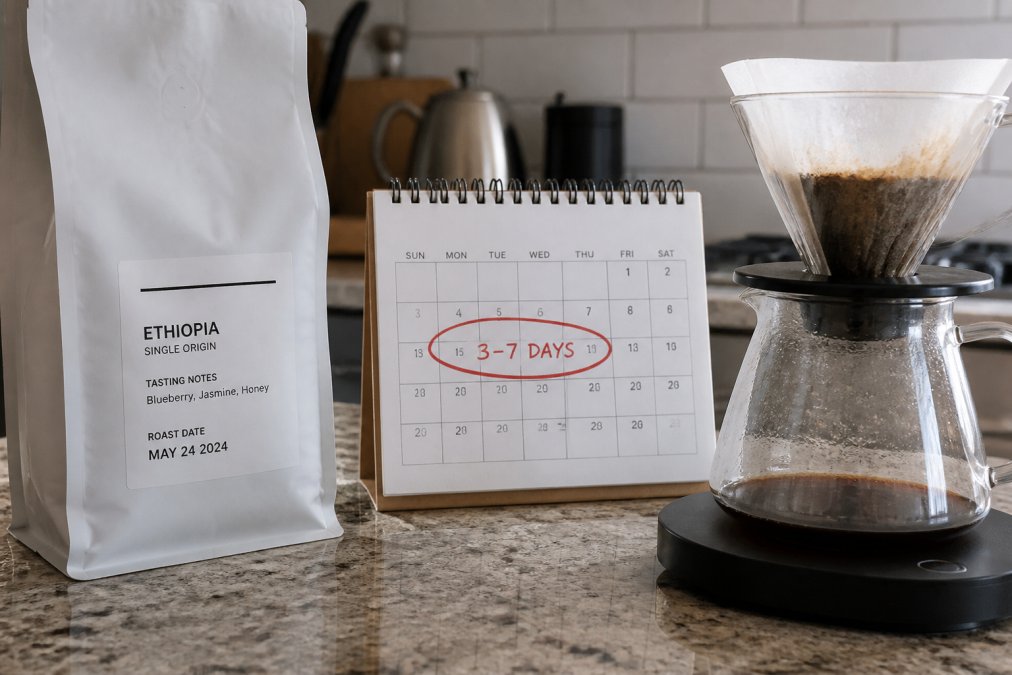
That middle window is the key insight: a bag that arrives three days after its roast date is often at its best, while a bag that arrives next-day is often still too fresh to brew well. Speed and quality are not the same axis.
A Decision Rule for Buyers
Instead of asking "how fast will it arrive," ask: what is the roast date, and when do I plan to brew?
- If you brew within 48 hours of delivery, look for a roast date 3-7 days before your expected arrival. That lands the coffee in the sweet spot on day one.
- If you brew over the following two weeks, a roast date 2-5 days before arrival is fine, you'll drink through the peak window.
- If you're buying as a gift or stocking up, prioritize a recent roast date over fast shipping. A bag roasted this week and shipped ground will beat a bag roasted last month and shipped overnight, every time.
This is why roast-to-order sellers can feel slower without being worse: the extra day or two is the roaster waiting for beans to be ready to package, not sitting on your order.
Where Pre-Roasted Inventory Fits
Pre-roasted inventory flips the trade-off: your order may ship same-day, but the beans could already be weeks old. That's a losing trade for anyone chasing flavor, unless the seller prints a roast date and rotates stock aggressively, in which case same-day shipping is a genuine advantage. If the listing doesn't show a roast date, assume the coffee is older than you'd like.
Best Practices for Receiving Fresh Coffee
Getting the most from a coffee delivery comes down to timing your order and storing beans well once they arrive.
- Order to align with the roaster's roasting schedule rather than against it
- Note the roast date on the bag, not just the shipping date
- Transfer beans to an airtight container once the bag is opened
- Keep whole beans whole until brewing; grind just before use
- Store away from light, heat, and moisture
For wholesale orders or large roast volume purchases, split the delivery into smaller shipments so you're not opening a big bag that stales before you finish it. Inventory management at home works the same way as in a cafe.
If you want convenience without the guesswork, Hall's Coffee & Tea offers single-serve options like our 12 Pack Single Serve Coffee Capsules, sealed with no oxygen inside to protect freshness, or the 60 Pack Single Serve Coffee Capsules for daily drinkers. Each capsule uses an improved filter design that absorbs more grounds for a lively cup without slowing the brew.


What to Do If Your Coffee Delivery Is Delayed
A delayed delivery is frustrating, but there's a clear sequence to follow. Check the tracking number for the last scan; a package stuck at one facility for more than two business days usually signals a carrier delay worth reporting.
Then contact customer support at the seller. A good roaster can confirm the ship date, reship a lost order, or explain a shipping policy on damaged goods. Most reputable sellers replace coffee that arrives damaged or leaking.
- Confirm the ship date with the seller
- File a claim with the carrier if tracking stalls
- Ask about reshipping for lost or damaged packages
- Review the seller's shipping policy before ordering again
Hall's Coffee & Tea includes free shipping on US orders, which removes one common source of delay-related cost. If you're unsure what to expect, the Instant Coffee pouch, with 30 servings in a resealable bag, is a low-commitment way to keep a fresh cup within reach while a larger order is in transit.

Frequently Asked Questions
How long does it typically take for roast-to-order coffee to ship?
Roast-to-order coffee usually ships within 1-2 business days after roasting. The roaster waits until your order is placed to roast the beans, so processing time adds a day or two compared to pre-roasted inventory. After shipping, transit time depends on your location and chosen carrier, typically 2-5 business days for standard shipping. Total delivery time from order to doorstep is often 3-7 business days for roast-to-order coffee.
What factors influence coffee delivery speed?
Several factors affect coffee shipping duration: your distance from the roaster, the shipping method selected (standard vs. expedited), carrier reliability, weather conditions, and order volume during peak seasons. Roast-to-order operations add processing time because beans are roasted after you order. Pre-roasted inventory ships faster but may sit longer before reaching you. Location matters most: coast-to-coast shipments take longer than regional deliveries.
Does 'out for delivery' mean my coffee will arrive today?
Usually yes, 'out for delivery' means your package is on the truck and should arrive by the end of the day. However, delays can happen due to high shipping volume, weather, or carrier issues. Check your tracking number for updates. If it still shows 'out for delivery' after the delivery window passes, contact the carrier. Most coffee delivery services recommend waiting until the next business day before reporting a missing package.
How can I track my coffee subscription delivery?
After your order ships, you'll receive a shipping confirmation email with a tracking number. Use that number on the carrier's website to see estimated arrival and transit updates. Many coffee delivery services also offer account dashboards where you can view order status and tracking history. If you don't receive a tracking number within 2 business days of ordering, check your spam folder or contact customer support for assistance.
