

How to Brew Fresh Roasted Coffee at Home: A 2026 Guide
Table of Contents
- Why Fresh Roasted Coffee Needs Time to Degas Before Brewing
- The Ideal Resting Period: When to Brew Your Beans
- The Coffee to Water Ratio That Makes Fresh Beans Shine
- Adjusting Grind Size, Water Temperature, and Bloom for Fresh Roasted Coffee
- How to Store Fresh Roasted Coffee Beans for Lasting Flavor
- Fresh Coffee Delivered to Your Door: Keeping Beans at Their Peak
- Conclusion
- Frequently Asked Questions
Last Updated: October 1, 2026
Why Fresh Roasted Coffee Needs Time to Degas Before Brewing
Fresh roasted coffee smells best right out of the roaster, but it is not yet at its most brewable. The beans are still releasing carbon dioxide, a natural byproduct of roasting that interferes with extraction.
How Roast Level Changes Degassing Time
Darker roasts degas faster: longer roasting cracks the bean's structure more, so carbon dioxide escapes sooner.
Here is a simple way to think about it:
- Light roasts: Dense beans, slow gas release, longer rest
- Medium roasts: Balanced release, moderate rest
- Dark roasts: Porous beans, fast release, shorter rest
The Ideal Resting Period: When to Brew Your Beans
The best resting period for fresh roasted coffee is 3 to 7 days after the roast date for most medium roasts, with peak flavor around day 5 to 10. Light roasts need longer; dark roasts are ready sooner.
Here is a practical resting guide:
| Roast Level | Minimum Rest | Peak Flavor Window |
|---|---|---|
| Light | 7-10 days | 10-14 days |
| Medium | 3-5 days | 5-12 days |
| Dark | 2-3 days | 4-8 days |
Why Roast Level Changes the Rest Timeline
Darker roasts degas faster because longer roasting cracks the bean's cell structure more thoroughly, giving carbon dioxide more escape routes. Light roasts keep a denser matrix, so gas leaves slowly.
Tasting the Difference: A Side-by-Side Rest Comparison
To know what rest does to your cup, taste the same beans at different rest days and compare deliberately.
- Aroma: Day 1 beans smell sharp and almost aggressive, with a pronounced roasty edge. By day 7, the aroma is rounder and the roast note has receded into the background.
- Acidity: Day 1 cups often taste sour or thin because the trapped gas is blocking even extraction. By day 7, the acidity reads as bright and structured rather than sharp.
- Body: Day 1 cups feel watery. The same beans at day 7-10 have noticeably more weight and sweetness, because the water can finally reach the compounds that create mouthfeel.
- Finish: Day 1 finishes short and hollow. Day 7 finishes long, with the sweetness and fruit notes carrying through.
Adjusting the Rest to Your Brew Method
Rest also depends on brew method. Espresso is far less forgiving of fresh beans than pour-over because pressure amplifies channeling: a bean that tastes fine in pour-over at day 3 can pull a gushing, sour shot until day 7 or later. Immersion methods like French press and AeroPress sit in the middle.
What Rest Does Not Fix
Rest cannot rescue stale beans or compensate for a bad roast. If beans taste flat at day 3 and still flat at day 10, the problem is the bean, the roast, or the storage. Buy from a roaster who prints a roast date, store properly, and treat rest as the final adjustment.
The Coffee to Water Ratio That Makes Fresh Beans Shine
A coffee to water ratio of 1:15 to 1:17 by weight works well for most fresh beans.
Adjusting Grind Size, Water Temperature, and Bloom for Fresh Roasted Coffee
Fresh roasted coffee needs a slightly coarser grind and a longer bloom than older beans. Carbon dioxide trapped in the bean's cell structure releases the moment hot water hits the grounds, pushing water away so the first seconds are spent fighting bubbles instead of dissolving sugars and acids. Grinding coarser gives water more space between particles, and blooming gives the gas a head start.
- Grind coarser than your recipe calls for, start one or two clicks coarser on a conical burr grinder, or one setting coarser on a flat burr. If your normal pour-over grind looks like table salt, fresh beans want something closer to coarse sand.
- Heat water to 195-205°F, just below boiling. Water at a full rolling boil scalds fresh aromatics and accelerates extraction past the point where you can control it.
- Bloom with twice the coffee's weight in water, 20 g of coffee gets 40 g of water. Pour in a spiral, then wait.
- Extend the bloom to 45-60 seconds for beans under 5 days old, and 30-45 seconds for beans 5-14 days old. The bloom is not a fixed step; it is a measurement.
- Pour the rest in slow circles, keeping the bed even and the water level steady.
- Total brew time: about 3 minutes for pour-over. If it runs past 3:30, coarsen the grind. If it finishes under 2:30, tighten it.
Reading the Bloom as a Freshness Gauge
The bloom tells you more than any label. Watch three things:
- Height: A bloom that puffs up like a mushroom and domes above the slurry means the beans are still actively releasing gas, typically days 1-4 post-roast.
- Sound: Audible crackling and fizzing is carbon dioxide escaping. A quiet bloom means most gas has already left.
- Collapse speed: A bloom that deflates within 15 seconds is a sign the beans are past their gassiest window and ready for a standard recipe.
Why Channeling Hits Fresh Beans Harder
Channeling is when water finds a weak path through the coffee bed and rushes through it, leaving the rest under-extracted. Aged coffee beds are relatively uniform; in fresh coffee, escaping gas creates fissures and pockets, and water follows the path of least resistance, tasting simultaneously sour and harsh.
Water Temperature: Small Adjustments, Big Effect
Water temperature is your fastest lever. Within the 195-205°F window:
- 195-198°F slows extraction and protects delicate floral and fruit notes in light roasts.
- 199-202°F is the middle ground that works for most medium roasts.
- 203-205°F pushes extraction harder, which suits dark roasts and beans that have already rested past their peak.
Matching the Recipe to the Rest Day
Fresh beans are a moving target. A simple adjustment map:
| Days Post-Roast | Grind | Bloom | Water Temp |
|---|---|---|---|
| 1-3 | Coarsest | 60 sec | 195-198°F |
| 4-7 | Coarse | 45-60 sec | 198-201°F |
| 8-14 | Standard | 30-45 sec | 200-203°F |
| 15+ | Standard to fine | 30 sec | 202-205°F |
Water Chemistry and Why It Matters for Extraction
Water makes up more than 98% of your cup, so its mineral content shapes extraction as much as your beans do. This matters more with fresh beans, because freshly roasted coffee is chemically reactive, its aromatic compounds bind aggressively to whatever is dissolved in your water.
Two minerals matter most:
- Magnesium pulls out fruity, bright flavors. It binds to the acidic compounds that give fresh coffee its liveliness.
- Calcium adds body and rounds out sweetness. It contributes to the perception of weight and mouthfeel.
A Quick Diagnostic for Fresh-Bean Cups
When a cup from fresh beans tastes wrong, the cause is usually one of four things:
- Sour and thin: under-extracted. Tighten the grind, raise the water temperature, or extend the bloom.
- Bitter and harsh: over-extracted. Coarsen the grind or drop the temperature a few degrees.
- Flat and hollow: water chemistry problem. Check your mineral content before you blame the beans.
- Inconsistent from cup to cup: channeling. Slow the pour, extend the bloom, and make sure the bed is level before you start.
How to Store Fresh Roasted Coffee Beans for Lasting Flavor
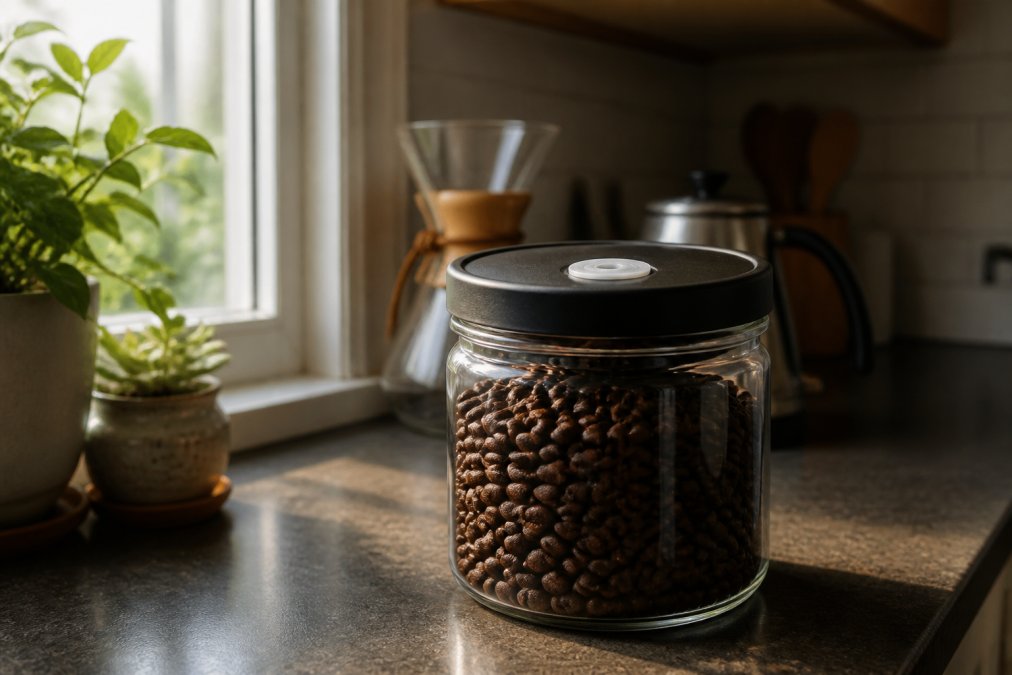
Store fresh roasted coffee beans in an airtight, opaque container at room temperature, away from light, heat, and moisture. Skip the fridge and freezer for daily-use beans. Temperature swings and condensation do more harm than good.
Four enemies shorten shelf life:
- Air: oxidizes oils and dulls flavor
- Light: breaks down compounds in the bean
- Heat: speeds up staling
- Moisture: invites stale, cardboard-like notes
Fresh Coffee Delivered to Your Door: Keeping Beans at Their Peak
Fresh coffee delivered to your door solves home brewing's biggest problem: getting beans that are actually fresh. Supermarket bags often sit for months, and by the time you open them the best flavors are gone.
- Brazil Santos with cocoa notes and a smooth, elegant cup
- Colombia with dried orange, berry, and chocolate
- Guatemala with dark chocolate, bright fruit, and butterscotch
- Peru with salted caramel, silky sweetness, and citrus
Conclusion
Getting fresh roasted coffee to taste its best comes down to patience and small adjustments: let the beans rest, grind coarse enough, bloom well, and store right.

Frequently Asked Questions
How long should you let coffee beans rest after roasting before brewing?
Most beans need 3 to 7 days of rest after roasting to degas enough carbon dioxide. Lighter roasts may need 7 to 10 days, while darker roasts can be ready in 2 to 3 days. Brewing too soon leads to foamy, uneven extraction and a sour or flat taste. If you buy from a local roaster, ask for the roast date and plan to wait at least three days before grinding.
What is the best coffee to water ratio for fresh roasted coffee?
Start with a 1:15 or 1:16 coffee to water ratio by weight. For one 8-ounce cup, use about 15 grams of coffee to 240 grams of water. Fresh beans release more gas, so you may need to adjust slightly: if the cup tastes weak, tighten the ratio to 1:14; if it tastes harsh, loosen to 1:17. A digital scale makes consistency much easier than scoops.
How should I store fresh roasted coffee beans to keep them tasting good?
Keep beans in an airtight, opaque container at room temperature, away from light, heat, and moisture. A one-way valve bag works well for the first two weeks. Do not refrigerate or freeze unless you plan to store for more than a month, and if you freeze, use a vacuum-sealed bag and let beans thaw fully before grinding. Grind just before brewing for the best flavor.
Does brewing fresh roasted coffee require special equipment?
No special equipment is required. A burr grinder, a digital scale, and a pour-over dripper or French press are enough to make excellent fresh coffee. A thermometer helps you hit the right water temperature (195-205°F), and a timer keeps your brew consistent. If you want to simplify, a drip machine with a bloom cycle works fine, but fresh beans still benefit from a quick stir during the bloom.
