

How to Identify Premium Arabica Coffee Beans
Table of Contents
- How to Identify Premium Arabica Coffee Beans by Sight and Smell
- Arabica vs Robusta Taste Profile: What Your Palate Should Notice
- Specialty Coffee Grading Standards and Reading the Label
- Signs of Stale Coffee Beans and the Freshness Factor
- Elevation, Density, and What They Mean for Flavor
- Common Mistakes When Buying Arabica Beans
- Putting It All Together: Choosing Premium Arabica Beans
- Frequently Asked Questions
Last Updated: September 23, 2026
How to Identify Premium Arabica Coffee Beans by Sight and Smell
You can spot premium arabica coffee beans before you ever brew them by checking three things: shape, crease, and smell. Arabica beans are oval with a curved S-shaped crease, and fresh ones smell sweet and complex rather than flat or papery. At Hall's Coffee & Tea, the beans that scored highest almost always looked and smelled right straight out of the bag.
That's the short answer. The longer one matters more, because most buyers get burned by beans that look fine but taste dull.
Below, we'll walk through exactly what to look at, what to smell, and which red flags mean you should send the bag back. You'll also learn why elevation and density quietly shape everything in your cup.
Bean Shape and the S-Shaped Crease
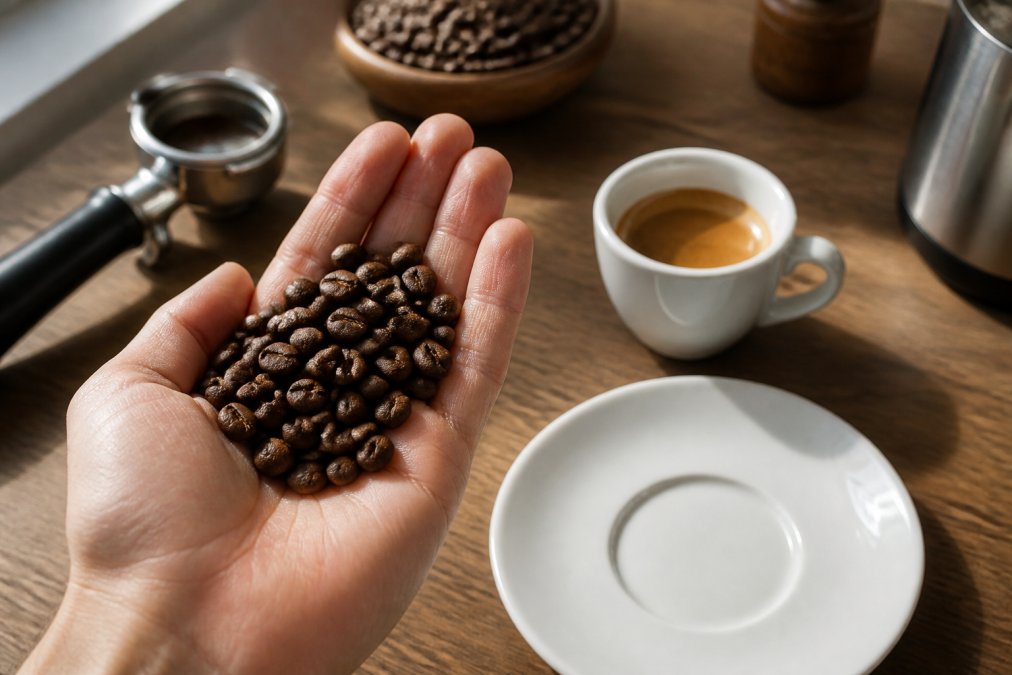
Bean anatomy is your first filter. Arabica beans are oval and slightly flat, with a wavy crease running down the middle.
That crease is the giveaway. On arabica, it curves like an S or a lazy zigzag. On robusta, it's usually straight or nearly so.
Size helps too, but less than people think. Arabica beans tend to run smaller and denser than robusta. Big beans aren't automatically better; uniform beans are.
Visual Cues of Roast Level and Freshness
Roast level shows up in color, and freshness shows up in oil and smell.
- Light roast: dry surface, light brown, no visible oil
- Medium roast: even brown, matte finish, faint sheen
- Dark roast: dark brown to near-black, glossy with surface oil
A little oil on a dark roast is normal. Heavy oil on a medium roast usually means the beans sat too long.
Then smell the bag the moment you open it. Fresh beans release a sweet, layered aroma. Stale beans smell like cardboard, sawdust, or nothing at all.
Arabica vs Robusta Taste Profile: What Your Palate Should Notice
The arabica vs robusta taste profile comes down to one word: smoothness. Arabica delivers sweetness, acidity, and layered flavor notes. Robusta brings bitterness, heaviness, and a rubbery or grainy edge.
Here's what to look for when you taste:
- Acidity: a bright, fruity snap, not a sour burn
- Body: medium weight, coating but not syrupy
- Aroma: floral, citrus, cocoa, or berry notes that shift as the cup cools
- Finish: clean and lingering, never astringent or drying
That last point separates good from great. Astringent means your mouth feels chalky afterward. Premium arabica should leave a clean finish.
Robusta has more caffeine content, roughly double in most comparisons.
Specialty Coffee Grading Standards and Reading the Label
Specialty-grade coffee sits at the top of the green coffee grading scale, and the term has a specific, testable definition rather than a marketing one. The widely used industry standard scores green coffee on a 100-point scale during cupping, and specialty coffee must clear 80 points with no primary defects present in the sample.
Here is how the tiers generally break down:
-
Specialty (80+ points): zero primary defects, no more than a small allowance of secondary defects, distinct and layered flavor attributes
-
Premium (roughly 75-80 points): clean cup, but flatter and less distinctive
-
Commodity (below 75 points): defects present, muted or off flavors
-
Origin: country, region, sometimes the exact farm
-
Altitude: the growing elevation in meters
-
Process: washed, natural, or something in between
-
Roast date: the day it was roasted, not a 'best by' date
Sourcing Transparency and Certifications
Label transparency is the single best signal of quality you can check without tasting. A roaster who names the farm, the cultivar, and the processing method has nothing to hide.
Specialty Coffee Association's cupping standards
Signs of Stale Coffee Beans and the Freshness Factor
Stale coffee beans announce themselves fast if you know the signs. The clearest one is smell: fresh beans smell sweet and alive, stale beans smell like paper or nothing.
Other signs to check:
- No roast date on the bag, or a date more than a few weeks old
- Oily, slick surface on a medium roast
- Flat, muted aroma when you open the bag
- Dull color with no variation across beans
- Bitter or cardboard taste in the cup
Elevation, Density, and What They Mean for Flavor
Elevation is the quiet variable behind almost every great cup, and the mechanism is worth understanding because it explains almost everything else on the label.
- Roasting: dense beans absorb heat more slowly and roast more evenly, which gives a roaster more control over developing sweetness without scorching.
- Storage: dense beans hold their oils and aromatics longer, so they stay fresh further past the roast date.
- Grinding: dense beans fracture more predictably, which matters for consistent extraction.
| Coffee | Altitude | Process | Flavor Notes |
|---|---|---|---|
| Bali Blue | 1,200-1,600 m | Wet-hulled | Dark chocolate, molasses |
| Colombia | 1,300-1,500 m | Fully washed | Dried orange, berry |
| Costa Rica | 1,300-1,445 m | Eco-pulped | Sweet apple, raisin, honey |
| Brazil Santos | 750-1,050 m | Pulped natural | Cocoa, smooth finish |
How to Judge an Elevation Claim on a Bag
Altitude on a label is only useful if you know what to do with it. A few practical rules:

- Above 1,200 m is the range most buyers associate with brighter, more complex arabica. Many specialty lots sit between 1,200 and 1,800 m.
- Below 1,000 m tends to produce softer, rounder cups, pleasant, but rarely the layered, high-acidity profile that earns a premium price.
- A missing altitude is itself information. If a roaster names the farm but not the elevation, ask. Serious roasters usually know it.
- Altitude is not a guarantee. A high-grown bean that was poorly processed or badly roasted can still taste flat. Elevation raises the ceiling; it does not set the floor.
Specialty Coffee Association's cupping standards
Common Mistakes When Buying Arabica Beans
The biggest mistake is trusting the word "arabica" on the bag. It's a species, not a grade. Plenty of low-grade arabica exists, and it tastes like it.
Other common errors:
- Chasing "100% arabica" as a quality claim. Every arabica bag says this. It tells you nothing about grade or freshness.
- Ignoring the roast date. A beautiful bag with no date is a gamble.
- Buying pre-ground for a "fresh" habit. Grinding releases aromatics fast; whole bean holds them far longer.
- Assuming dark roast means stronger. It means roastier, not more caffeinated.
- Overpaying for packaging. A shiny bag with no origin info is marketing, not quality.
Putting It All Together: Choosing Premium Arabica Beans
So how do you actually buy well? Use a simple checklist every time you shop.
- Beans are oval with a curved S-shaped crease
- Roast date is printed and recent
- Origin names a region, farm, or grower
- Altitude is listed, ideally above 1,200 m
- Process is named (washed, natural, or similar)
- Aroma is sweet and layered when you open the bag
- Surface oil matches the roast level
- No astringent or papery notes in the cup
Frequently Asked Questions
How can you tell the difference between Arabica and Robusta beans?
Arabica beans are oval with a pronounced S-shaped crease, while Robusta beans are smaller, rounder, and have a straighter crease. In the cup, Arabica tastes smoother with noticeable acidity and layered flavor notes like fruit or chocolate. Robusta tastes harsher, more bitter, and carries a rubbery or grainy edge. If a bag does not state the species, the bean shape and crease are your best visual clues before brewing.
Does the roast date affect the quality of Arabica beans?
Yes. Roasted Arabica beans hit peak flavor roughly 4 to 14 days after the roast date, then decline. Bags with only a 'best by' date hide the real age. Look for a printed roast date, and buy from providers that label it clearly. Store beans in an airtight container away from light and heat, and finish the bag within about four to six weeks of the roast for the best sensory profile.
What should I look for on coffee packaging to ensure premium quality?
Look for a specific roast date, the country or region of origin, the farm or grower name, the elevation in meters, the processing method (washed, natural, or pulped natural), and the variety or cultivar. Specialty coffee grading standards also favor bags that mention a cupping score or a grade like 'specialty.' Vague terms such as 'gourmet' or 'premium blend' without those details tell you little about actual quality.
How does bean density impact the flavor of Arabica coffee?
Denser beans, usually grown at higher elevations, develop more sugars and complex acids inside the seed. That density shows up in the cup as brighter acidity, clearer flavor notes, and a heavier body. You can feel density by picking up a bean: high-altitude Arabica feels solid and heavy for its size. Lower-density beans from lower elevations tend to taste flatter and less sweet.
