

How to Steep French Press Coffee for Best Flavor
Table of Contents
- Why Immersion Brewing Rewards Precision
- French Press Coffee Grind Size: The Foundation of Flavor
- The French Press Coffee Ratio That Balances Body and Clarity
- French Press Brew Time: Why Minutes Matter More Than You Think
- Step-by-Step: How to Steep French Press Coffee for Best Flavor
- Decanting vs. Leaving Coffee in the Press
- Choosing Beans That Shine in a French Press
- Troubleshooting: Fixing Bitter, Weak, or Muddy Cups
- Frequently Asked Questions
Last Updated: September 18, 2026
Why Immersion Brewing Rewards Precision
Learning how to steep French press coffee for best flavor comes down to one idea: full immersion rewards control. Unlike a pour-over, a French press keeps coffee and water in contact the whole time, so every variable you set, grind size, ratio, temperature, and time, changes what ends up in your cup.
French Press Coffee Grind Size: The Foundation of Flavor
French press coffee grind size should be coarse, roughly the texture of sea salt or raw sugar. The mesh filter catches large particles, so fine grounds slip through and keep extracting in your cup, while coarse grounds stay put for a clean, full-bodied brew.
Why Coarse Grind Matters for the Mesh Filter
A French press uses a metal mesh filter, not paper, and mesh doesn't trap fine particles. Too-fine grounds pass into the carafe and keep steeping after you plunge, leaving a muddy cup that gets more bitter the longer it sits.
Fines, Sediment, and What Your Grinder Contributes
Fines are the tiny dust-like particles every grinder produces, even on a coarse setting. A blade grinder chops unevenly and creates far more of them; a burr grinder crushes beans to a consistent size, so you get fewer fines and less sediment.
The French Press Coffee Ratio That Balances Body and Clarity
The standard French press coffee ratio is 1:15, one gram of coffee to 15 grams of water, about 24 grams for a 12-ounce (355 ml) press. That gives you full body without the heaviness of an overloaded basket.
Using a Digital Scale for Consistent Brews
A digital scale is the cheapest upgrade you can make. Scoops vary wildly depending on grind and bean density. Weighing in grams removes the guesswork and lets you repeat a good cup exactly.
Adjusting Your Ratio for Tasting Notes and Mouthfeel
| Ratio | Coffee (per 12 oz) | Result |
|---|---|---|
| 1:12 | 30 g | Heavy body, bold, lower clarity |
| 1:15 | 24 g | Balanced body and clarity |
| 1:17 | 21 g | Lighter body, brighter acidity |
Start at 1:15, then move one step in either direction based on what you taste.
French Press Brew Time: Why Minutes Matter More Than You Think
French press brew time runs about four minutes total, including a 30-second bloom. Steep too briefly and the cup tastes weak and sour. Steep too long and tannins and bitter compounds take over. Four minutes is the sweet spot for most coarse-ground coffee.
The Bloom: Your First 30 Seconds
Pour just enough hot water to saturate the grounds, then wait 30 seconds. The grounds swell and release trapped gas, which is why the bed puffs up; skipping the bloom traps that gas and causes uneven extraction.
Reading Visual Indicators of Extraction
You don't need a refractometer to judge a brew. Watch the surface:
- A thick, even crust after the bloom means fresh coffee and a good grind.
- Dark foam with no bubbles suggests the water was too cool.
- A thin, watery-looking bed usually means the grind is too coarse.
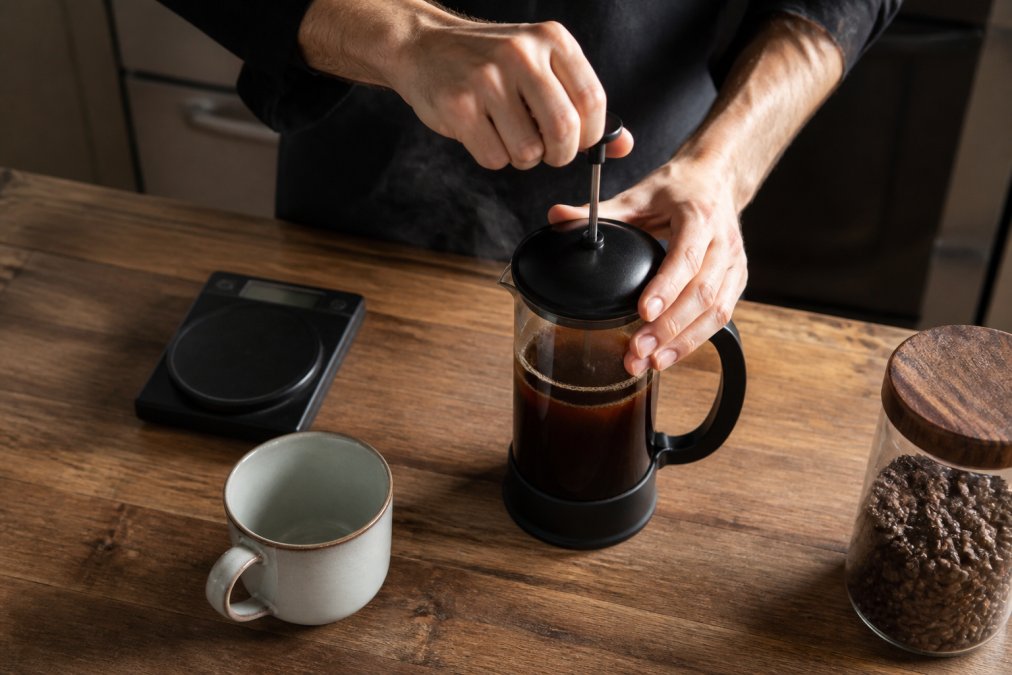
Step-by-Step: How to Steep French Press Coffee for Best Flavor
- Preheat the carafe. Fill it with hot water, swirl, and dump it out.
- Weigh and add coffee. Use 24 grams for a 12-ounce press.
- Bloom. Pour 60 grams of water, stir gently, and wait 30 seconds.
- Add the rest of the water. Pour to 355 grams, aiming for 195-205°F.
- Steep for four minutes. Leave the plunger up.
- Break the crust. Stir once, then skim off the foam.
- Plunge slowly. Push down with steady, even pressure over 20 seconds.
- Pour immediately. Don't let the coffee sit on the grounds.
Water Temperature and Pre-Heating Your Carafe
Water temperature should land between 195°F and 205°F, just off a boil; boiling water scalds the grounds and pulls out harsh, bitter notes. A cold carafe drops brew temperature fast, so pre-heating keeps the steep even.
Water Chemistry: The Variable Nobody Talks About
Water is roughly 98% of the finished beverage, so its mineral content matters as much as your beans.
Two numbers drive flavor:
-
Total hardness (calcium and magnesium). These minerals bind to coffee compounds and pull them into solution. Too soft, distilled, reverse-osmosis, or heavily filtered, extracts poorly and tastes flat and papery; too hard mutes acidity and leaves a chalky finish.
-
Alkalinity (bicarbonate). This buffers acidity. High alkalinity flattens bright, fruity notes; very low alkalinity lets acidity run sharp and metallic.
-
Bottled spring water with a mineral content printed on the label usually lands in a workable range. Avoid distilled and "purified" waters.
-
Third-wave water packets or brewing salts let you build water from scratch. A quarter-teaspoon of a magnesium-and-bicarbonate blend in a gallon of distilled water gets you into the target zone.
The Plunge Technique and Advanced Agitation
Press the plunger down slowly and steadily; pushing fast stirs up sediment and clouds the cup. For a cleaner result, stir gently at the four-minute mark, then let the grounds settle 30 seconds before plunging.
Three agitation styles worth trying:
- No stir at all. Pour, bloom, pour, wait four minutes, plunge. Cleanest cup, lowest body, and the most forgiving if your grind runs fine.
- One stir at the bloom, one at four minutes. The standard approach. Balanced extraction with moderate sediment.
- Continuous gentle stir for the first 30 seconds. Maximum extraction, heaviest body, and the most sediment. Best reserved for coarser grinds and darker roasts that can take the extra contact time.
Decanting vs. Leaving Coffee in the Press
Pour every cup out as soon as you finish plunging. Coffee left on the grounds keeps extracting, so the second cup always tastes more bitter and astringent. If you brew more than you'll drink right away, decant the rest into a separate carafe or thermos, this habit fixes more "bitter French press" complaints than any other change.
The rate of that drift depends on three things:
- Temperature. A press that's still at 190°F will over-extract far faster than one that's cooled to 150°F. If you can't decant immediately, the next best move is to let the press cool.
- Grind. Finer grinds have more surface area and over-extract faster. A coarse grind buys you a few extra minutes of grace.
- Volume remaining. A nearly empty press has less liquid to dilute the newly extracted compounds, so the last cup is always the harshest.
How to Decant Without Losing Heat
Decanting into a cold mug or carafe drops the temperature fast. Two fixes:
- Pre-warm your serving vessel with hot water the same way you pre-heat the press. A 30-second swirl is enough.
- Use a thermal carafe or a pre-warmed thermos if you plan to drink over 20-30 minutes. A good thermos holds brew temperature for well over an hour, which is more than enough for a second cup.
A Note on the "Second Cup" Myth
Some guides claim the second cup from a French press is always inferior. That's only true if you leave the coffee in the press. Decanted into a pre-warmed carafe, the second cup tastes nearly identical to the first for 15-20 minutes, then gradually loses aromatics as it cools. The bitterness people blame on the "second cup" is almost always over-extraction from sitting on the grounds.
Choosing Beans That Shine in a French Press
Medium and medium-dark roasts work best in a French press, their fuller body and lower acidity match the method. Very light roasts can taste thin and sharp because the coarse grind and short steep don't pull out enough of their sugars.
- Brazil Santos ($18.99): elegant and smooth with cocoa notes, a natural fit for a balanced press.
- Guatemala ($18.99): dark chocolate, bright fruit, and butterscotch, with enough body to hold up to a full steep.
- Sumatra ($17.99): syrupy body with dark chocolate and earthy notes, ideal if you like a heavy, low-acid cup.
- House Blend ($18.99): a smooth, consistent medium roast with nutty and sweet chocolate notes, a dependable everyday pick.
Troubleshooting: Fixing Bitter, Weak, or Muddy Cups
Most French press problems trace back to grind, time, or temperature. Use this table to diagnose your cup:

| Problem | Likely Cause | Fix |
|---|---|---|
| Bitter, harsh | Steep too long or water too hot | Cut steep to 3:30, cool water to 200°F |
| Weak, sour | Grind too coarse or steep too short | Grind finer, extend steep to 4:30 |
| Muddy, full of sediment | Too many fines | Switch to a burr grinder |
| Thin body | Ratio too weak | Tighten to 1:13 |
| Second cup tastes worse | Coffee left on grounds | Decant immediately after plunging |
Frequently Asked Questions
How long should French press coffee steep for the best flavor?
Four minutes is the standard starting point for most French press coffee. During this time, the coarse grounds release oils, acids, and sugars into the water. If the cup tastes weak or thin, extend to 4 minutes 30 seconds. If it tastes bitter or drying, pull back to 3 minutes 30 seconds. Your french press brew time should always be adjusted based on the roast level and grind consistency, not treated as a fixed rule.
What is the right french press coffee ratio for a balanced cup?
Start with 1 gram of coffee per 15 milliliters of water, roughly a 1:15 ratio. For a standard 34-ounce French press, that means about 60 grams of coarse grounds to 900 milliliters of water. If you prefer a heavier body and bolder mouthfeel, tighten the ratio to 1:12. For a lighter, tea-like cup, loosen it to 1:17. Weigh both coffee and water on a digital scale for repeatable results.
Why does my French press coffee taste bitter or muddy?
Bitterness usually comes from over-extraction, which happens when the grind is too fine, the water is too hot, or the steep runs too long. Muddy texture points to excessive fines passing through the mesh filter. Switch to a coarser grind, let water cool to between 195 and 205 degrees Fahrenheit before pouring, and decant the coffee into a separate carafe immediately after plunging to stop the extraction.
Does water temperature really affect French press flavor?
Yes. Water between 195 and 205 degrees Fahrenheit extracts the full range of tasting notes without scorching the grounds. Boiling water above 205 degrees pulls out harsh tannins and creates a sharp, bitter cup. If you do not have a variable-temperature kettle, boil water and let it rest for 30 to 45 seconds before pouring. Pre-heating your carafe with hot water also keeps the slurry temperature stable throughout the steep.
Steeping French press coffee well is a skill you can build in a week of morning brews. The variables are simple, but the payoff is a cup that tastes the way the roaster intended. Hall's Coffee & Tea sources single-origin beans and blends with that ritual in mind, from the smooth House Blend to the syrupy Sumatra. Shop coffee with free shipping, and start with beans fresh enough to bloom the way they should.
