

Ethical Sourcing in Specialty Coffee: 2026 Guide
Table of Contents
- Why Ethical Sourcing Practices in Specialty Coffee Matter Now
- Fair Trade Coffee Certification Standards: What the Labels Actually Require
- Direct Trade Coffee Benefits for Farmers and Your Cup
- The Greenwashing Trap: How to Spot Marketing Spin
- How to Identify Ethically Sourced Coffee Beyond the Logo
- The Economic Breakdown of a Cup: Where Your Money Goes
- Post-Harvest Processing Ethics and Supply Chain Technology
- Conclusion
- Frequently Asked Questions
Last Updated: September 26, 2026
Why Ethical Sourcing Practices in Specialty Coffee Matter Now
Ethical sourcing coffee practices are the verified methods roasters use to ensure farmers are paid fairly, land is farmed responsibly, and every step from seed to cup can be traced. At Hall's Coffee & Tea, we've watched this shift move from niche concern to mainstream expectation, and for good reason.
Coffee is one of the most traded agricultural commodities on earth, and the gap between what farmers earn and what consumers pay has stayed stubbornly wide for decades. A roaster's sourcing choices ripple across entire communities, affecting everything from school fees to soil health. That's the core tension running through this guide: most "ethical" labels tell you very little, and the real signals live in the details.
Below, we'll show you exactly how to read certifications, spot greenwashing, and trace where your money actually goes. The stakes are simple. When sourcing is done right, your cup tastes better and the people who grew it build a future.
Fair Trade Coffee Certification Standards: What the Labels Actually Require
Fair trade coffee certification standards are third-party rules that set minimum prices, labor protections, and environmental requirements for certified farms. The two best-known systems in the United States are Fairtrade International and Fair Trade USA, though their requirements differ in important ways.
Fairtrade International guarantees a minimum floor price that farmers receive even when the commodity market crashes, plus a social premium paid on top for community projects. Fair Trade USA runs a similar model but certifies both smallholder cooperatives and larger estates, which some advocates criticize.
What matters for you as a buyer:
- Minimum price guarantees protect farmers when market prices fall
- Social premiums fund schools, clinics, and infrastructure
- Environmental standards restrict certain pesticides and require shade management
- Independent audits verify compliance, though audit frequency varies
The honest limitation: certification costs money, and small farms sometimes can't afford the fees. That means the most vulnerable growers are occasionally left outside the system. Certification is a floor, not a ceiling.
Direct Trade Coffee Benefits for Farmers and Your Cup
Direct trade coffee benefits start with the relationship. Instead of buying through layers of intermediaries, roasters negotiate directly with farms or cooperatives, often paying well above commodity prices and visiting the source.
The upside for farmers is obvious: better prices, more predictable contracts, and feedback on quality that helps them improve. For your cup, direct relationships often mean fresher lots, more traceable origins, and the ability to ask hard questions about labor and land practices.
But here's what most guides miss. "Direct trade" isn't a regulated term. Any roaster can print it on a bag without proving a thing. The real difference between genuine direct trade and marketing copy comes down to transparency: does the roaster name the farm, the region, the altitude, and the price paid? If not, treat the claim with skepticism.
A common mistake is assuming direct trade automatically beats certification. In practice, the strongest programs combine both: direct relationships plus third-party verification of the claims being made.
The Greenwashing Trap: How to Spot Marketing Spin
The greenwashing trap is the gap between a coffee bag's imagery and what's actually verifiable behind it. Vague phrases like "sustainably minded," "ethically inspired," or "farm-friendly" carry no legal weight and no audit trail.
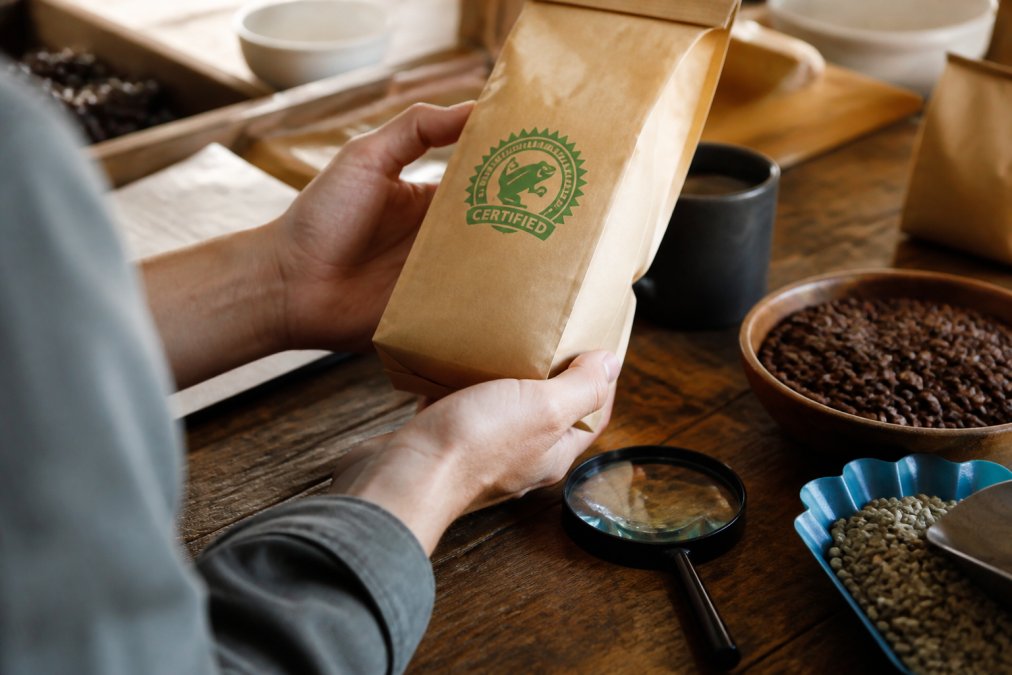
Watch for these red flags:
- Logos that look like certifications but aren't registered with any recognized body
- Claims about "supporting farmers" with no named farm or cooperative
- Sustainability language paired with no origin detail whatsoever
- Certifications mentioned but never shown on the packaging
The fix is straightforward. Look for a named certifier, a named origin, and a traceable supply chain. If a roaster can't tell you where the beans came from and who verified the claims, the ethics are decoration.
How to Identify Ethically Sourced Coffee Beyond the Logo
Learning how to identify ethically sourced coffee means looking past the seal and reading the story on the bag. Here's a practical checklist you can use in the aisle or online:
- Is the farm, cooperative, or region named specifically?
- Is the certifying body a recognized organization like Fairtrade International or Fair Trade USA?
- Does the roaster publish what price was paid to the farmer?
- Are the farming practices described, such as shade-grown or pesticide-free?
- Is there a roast date, not just a best-by date?
- Can you find the roaster's sourcing policy on their website?
A roaster that answers most of these is doing real work. One that answers none is selling a feeling.
This is where Hall's Coffee & Tea approaches sourcing differently. Our Bali Coffee Pods, for example, come from smallholder farmers in the Kintamani region, grown at 1,200 to 1,600 meters on volcanic loam soil and hand-picked before wet-hulling. That level of origin detail is exactly the kind of transparency that separates genuine ethical sourcing from a marketing slogan.

The Economic Breakdown of a Cup: Where Your Money Goes
Most of what you pay for coffee never reaches the farm.
- Milling and export, dry milling, sorting, bagging, and freight to port. This is a real cost, but it is also where opaque intermediaries historically compressed farmer margins.
- Import and logistics, shipping, customs, warehousing, and financing. Coffee is a commodity that ties up capital for months before it is roasted.
- Roasting, green coffee loses roughly 15-20% of its weight during roasting, so a roaster buys more green pounds than it sells roasted. That shrinkage is a genuine cost, not padding.
- Packaging and retail, bags, valves, labels, shelf space, and the markup a cafe or grocery store needs to stay open.
Transparency here is the whole game. A bag that names the farm, the region, the harvest year, and the price paid tells you more than any certification seal ever could. The economic breakdown is not about shaming any single link in the chain. It is about knowing which link is being squeezed, and choosing roasters who publish enough for you to see it.
Post-Harvest Processing Ethics and Supply Chain Technology
- QR-code traceability, A code on the bag resolves to a record of the farm, the mill, the processing method, and the harvest date. The value depends entirely on who enters the data and whether it is audited. A QR code that leads to a marketing page is theater; one that leads to a mill-level record is evidence.
- Blockchain-based ledgers, These create tamper-resistant records of custody transfers, which helps when coffee changes hands across borders. The catch is the same as any database: garbage in, garbage out. Blockchain proves a record wasn't altered after entry; it does not prove the entry was true.
- Mobile payments, Digital payment rails reduce the cash-handling middlemen who historically skimmed farmer earnings and can create a payment trail that cooperatives and buyers can audit.
- Remote sensing and soil monitoring, Satellite and sensor data let cooperatives document shade cover, water use, and land practices without flying in an auditor for every farm.
USDA Organic certification program overview
A practical rule: when you see a QR code or a traceability claim, scan it. If it shows you a named farm, a named mill, a processing method, and a price or living-income reference, the technology is doing real work. If it shows you a brand story, it is decoration.
Conclusion
The hard part of ethical sourcing coffee isn't finding a label. It's cutting through the marketing to see what's actually verified behind the bag. At Hall's Coffee & Tea, we build our sourcing around named origins, transparent practices, and single-origin selections like our Bali Coffee Pods, Whiskey Barrel Aged Guat, and our mushroom-infused roasts. Every order ships free, arrives fresh, and is backed by secure checkout.
Frequently Asked Questions
What is ethical sourcing in coffee?
Ethical sourcing in coffee means buying beans in a way that supports fair wages, safe labor conditions, and environmental care throughout the supply chain. It includes practices like paying above commodity prices, using shade-grown methods, and ensuring traceability from farm to roaster. For consumers, it means looking beyond a label to understand how the coffee was produced and traded.
What is the difference between Fair Trade certification and direct trade models?
Fair Trade certification sets baseline social, economic, and environmental standards that cooperatives must meet, verified by third-party auditors. Direct trade skips the certification body; roasters build relationships directly with farmers, often paying higher prices for specific quality. Both aim to improve farmer livelihoods, but direct trade offers more flexibility and potentially higher premiums, while Fair Trade provides a recognizable, audited standard.
How can consumers verify ethical sourcing claims on coffee packaging?
Check for third-party certification logos like Fair Trade, Rainforest Alliance, or USDA Organic. Look for specific information: farm name, region, altitude, and processing method. Visit the roaster's website to see if they publish sourcing reports or farmer partnerships. If a bag only says 'sustainably sourced' without details, treat it as a marketing claim, not a verified fact.
How does ethical sourcing impact the quality of specialty coffee beans?
Ethical sourcing often leads to better quality because farmers who receive fair prices can invest in better harvesting, processing, and storage. For example, hand-picking ripe cherries and drying on raised beds, as seen in beans from smallholder farmers in Kintamani, Bali, requires care and resources. When farmers are paid fairly, they can focus on quality rather than volume, resulting in a more flavorful cup.
