

How to Brew Balanced Coffee at Home
Table of Contents
- Understanding Coffee Balance and Extraction
- Coffee to Water Ratio for Pour Over and Other Methods
- Grind Size Chart and How to Dial In Your Coffee
- Water Temperature, Quality, and Chemistry
- How to Fix Bitter Coffee and Other Extraction Problems
- Step-by-Step Brewing Guide for Balanced Results
- Equipment, Freshness, and Maintenance
Last Updated: August 26, 2026
Understanding Coffee Balance and Extraction
Brewing balanced coffee means achieving the sweet spot where acidity, bitterness, and sweetness coexist in harmony through proper extraction, the process where hot water dissolves desirable compounds from ground coffee while avoiding over-extraction (harsh, bitter) or under-extraction (sour, thin).
Balance comes from controlling five variables: water temperature, grind size, coffee-to-water ratio, contact time, and water quality. At Hall's Coffee & Tea, our House Blend and Breakfast Blend are formulated to maintain balance even with imperfect technique, but understanding extraction mechanics helps you dial in better results. The difference between mediocre and excellent often comes down to a few degrees of temperature or a slightly finer grind, small adjustments compound significantly.

Coffee to Water Ratio for Pour Over and Other Methods
The coffee-to-water ratio is the foundation of consistency and the easiest variable to control. The standard starting point is 1:16, one part coffee to 16 parts water by weight. This produces a balanced cup for most brewing methods. Prefer stronger? Try 1:15. Lighter? Try 1:17.
Weight matters more than volume. A scale costs $15-30 and eliminates guesswork, two tablespoons of coffee can weigh anywhere from 10 to 14 grams depending on grind size and packing. For pour-over, use 1:16; for French press, 1:15 works better since immersion extraction differs from percolation; for AeroPress, 1:17 is common due to shorter contact time.
The ratio affects not just strength but extraction itself. A weaker ratio (more water) can lead to over-extraction if contact time is too long. A stronger ratio (less water) can lead to under-extraction if water doesn't have enough time to pull out solids.
Grind Size Chart and How to Dial In Your Coffee
Grind size controls water flow speed and surface area contact. Finer grinds slow water flow and increase extraction; coarser grinds speed flow and decrease extraction.
| Brewing Method | Grind Size | Particle Size Range | Dial-In Target |
|---|---|---|---|
| French Press | Coarse | 0.75-1.0 mm | Consistency first, then adjust for taste |
| Pour Over | Medium | 0.5-0.75 mm | Start here, then fine-tune |
| AeroPress | Medium-Fine | 0.4-0.6 mm | Adjustable based on brew time |
| Espresso | Fine | 0.2-0.4 mm | Requires precise dialing in |
| Turkish | Very Fine | Powder-like | Consistency critical |
Dialing in means adjusting grind until extraction hits the target window. If your pour-over drains too fast (under 2 minutes), your grind is too coarse. If it drains too slowly (over 4 minutes), your grind is too fine and over-extracting.
A burr grinder is non-negotiable for consistency. Blade grinders produce uneven particle sizes, causing some coffee to under-extract while other particles over-extract, resulting in muddy, confused flavor.
The most common mistake is grinding too fine. Finer grinds mean longer contact time, leading to over-extraction and bitterness instead of origin flavor notes.
Water Temperature, Quality, and Chemistry
Water temperature is the accelerator of extraction. The ideal range for most brewing methods is 195-205°F, hot enough to extract efficiently without burning the coffee or extracting excessive bitterness (peer-reviewed research). If water is boiling (212°F), let it cool for 30 seconds. Below 190°F, extraction becomes sluggish and under-developed.
Water quality matters as much as temperature. Tap water varies by location, some is soft (low minerals), some hard (high minerals). Chlorine and sediment affect flavor. Ideal coffee water contains dissolved minerals, specifically magnesium and calcium, which help extract flavor compounds. Distilled water actually under-extracts; over-mineralized water can over-extract or taste flat.
Total Dissolved Solids (TDS) measures mineral content. For coffee, 150-250 parts per million (ppm) is optimal (peer-reviewed research). If your tap water is significantly harder or softer, filtering makes a measurable difference. A carbon filter removes chlorine and sediment while preserving beneficial minerals. Many brewers use filtered pitcher water as a middle ground.
How to Fix Bitter Coffee and Other Extraction Problems
Bitter coffee almost always means over-extraction. The water stayed in contact with grounds too long, pulling out harsh tannins and burnt flavors.
For pour-over, grind slightly coarser first. If bitterness persists, drop water temperature to 200°F. If it continues, speed up your pour, aim for 2.5-3.5 minutes total, not 4 or 5.
For French press, reduce brew time from 4 to 3 minutes, or use a slightly coarser grind to slow extraction at the same contact time.
Sour or grassy coffee means under-extraction. For pour-over, grind finer or increase water temperature to 205°F. For French press, extend brew time from 3 to 4 minutes. Balanced extraction produces clean, clear flavor notes with no harshness or sourness.
Step-by-Step Brewing Guide for Balanced Results
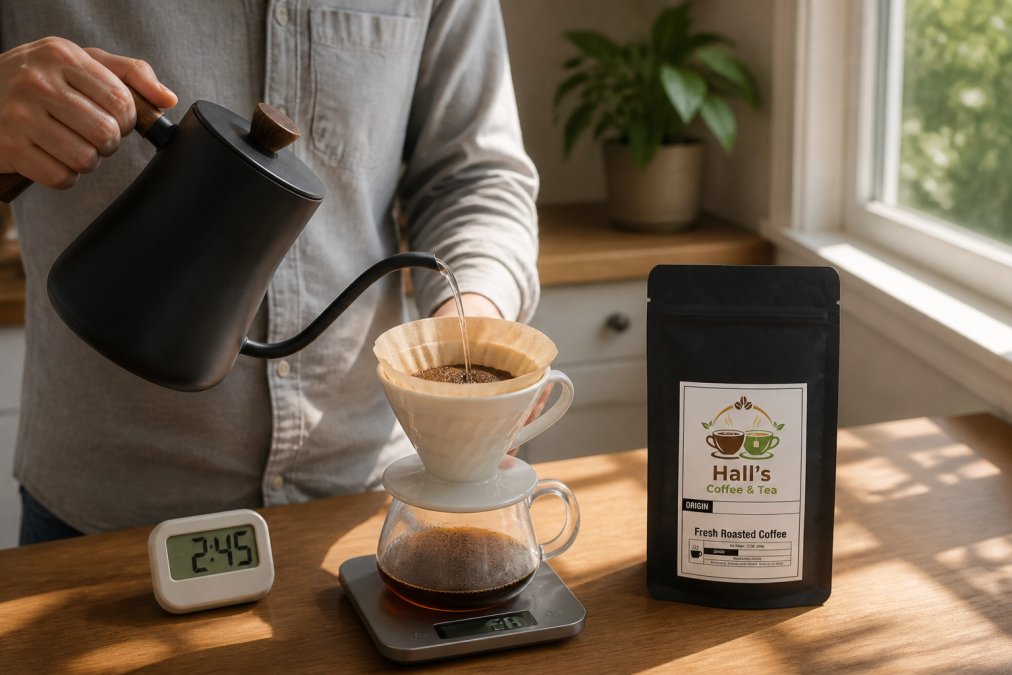
Total Time: 5 minutes
Difficulty: Beginner to Intermediate
What You'll Need:
- Coffee beans (freshly roasted, ideally within 2-4 weeks of roast date)
- Burr grinder
- Scale (digital, accurate to 0.1 grams)
- Brewing device (pour-over, French press, or AeroPress)
- Filtered water
- Kettle or gooseneck kettle
- Timer
- Mug or carafe
Step 1: Measure Your Coffee [Time: 1 minute]
Weigh 20 grams of whole beans for a single cup. Use your scale, don't eyeball it. For multiple cups, multiply accordingly (40 grams for two cups).
Step 2: Grind Your Coffee [Time: 1 minute]
Grind immediately before brewing. Use medium grind for pour-over (sea salt texture), coarse for French press, medium-fine for AeroPress. All particles should be roughly the same size.
Step 3: Heat Your Water [Time: 2 minutes]
Heat water to 200-205°F. If you lack a thermometer, boil and wait 30 seconds. Use filtered water if your tap water is notably hard or chlorinated.
Step 4: Bloom Your Coffee [Time: 30 seconds]
For pour-over: Pour just enough hot water to saturate grounds (about 40 grams of water for 20 grams of coffee). Let sit for 30 seconds to allow CO2 to escape and prepare beans for even extraction.
For French press: Skip the bloom and proceed to the full pour.
Step 5: Complete the Brew [Time: 2-3 minutes]
For pour-over: Pour remaining water slowly in circular motion. Finish pouring by 2:30 total time; water should drain completely by 3:30.
For French press: Pour all water, stir gently, place lid on top (don't press yet), and wait 4 minutes.
For AeroPress: Follow the standard 1-minute steep method or inverted method for longer contact time.
Equipment, Freshness, and Maintenance
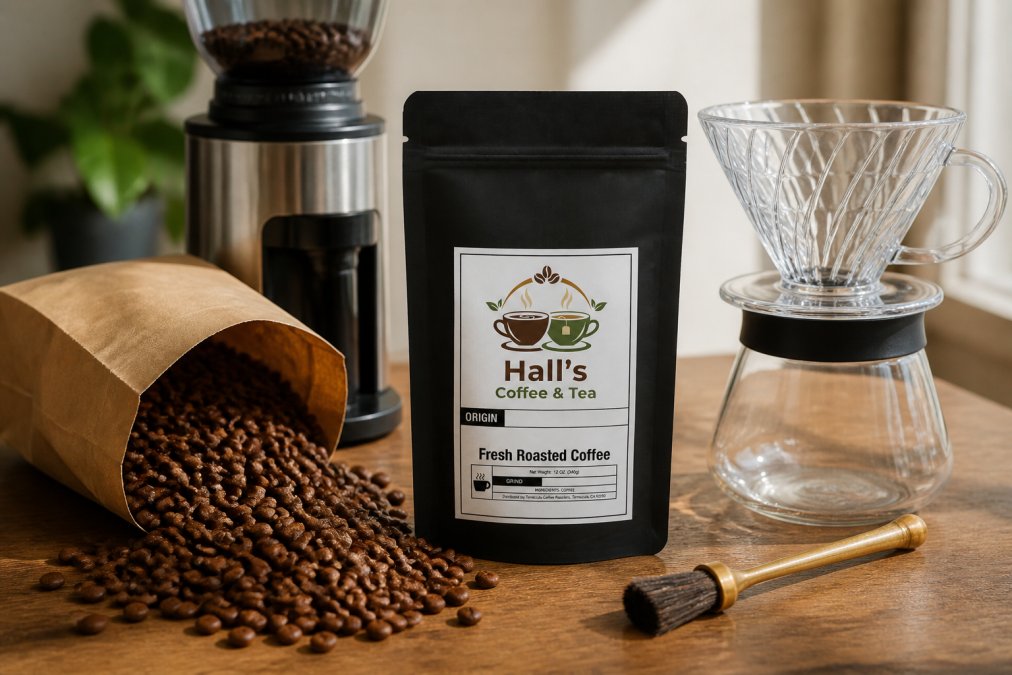
Your equipment doesn't need to be expensive, but it needs to be intentional. A $30 burr grinder and $15 scale will outperform a $200 espresso machine paired with a blade grinder.
The burr grinder is the single most important piece of equipment. Burrs crush beans between two rotating surfaces, producing uniform particle sizes. Blade grinders chop randomly, creating inconsistency. Upgrading to a burr grinder transforms your coffee more than any other single change.
Pour-over equipment (ceramic, glass, or plastic dripper) is affordable and forgiving. A gooseneck kettle gives better control over pouring, but a standard kettle works fine with careful pouring. French press is another solid option, simple, durable, and full-bodied.
Freshness is non-negotiable. Coffee loses flavor immediately after roasting. Whole beans stay fresh for 2-4 weeks after the roast date; ground coffee loses freshness within days (peer-reviewed research). Buy whole beans and grind immediately before brewing.
The roast date matters more than the sell-by date. A bag roasted 2 weeks ago is fresher than one roasted 8 weeks ago, even if the sell-by date is further out. Hall's Coffee & Tea prints the roast date on every bag. Stale beans taste flat and one-dimensional; fresh beans taste vibrant and complex.
Maintenance keeps equipment performing well. Rinse your dripper or French press immediately after each brew, coffee oils oxidize and turn rancid. Once weekly, soak your dripper in hot water with a small amount of dish soap, then rinse thoroughly. For burr grinders, purge old grounds before switching coffees. Hard water deposits can accumulate in kettles; soak affected equipment in equal parts white vinegar and water for 15 minutes, then rinse.
Conclusion
Brewing balanced coffee at home is learnable and repeatable. Start with the fundamentals: measure by weight, use filtered water, grind fresh, and hit your target brew time. From there, taste your cup and make small adjustments. Each adjustment teaches you how extraction works.
Ready to elevate your daily ritual? Start with Hall's Coffee & Tea's House Blend or Brazil Santos, both roasted for balanced, forgiving extraction across all home brewing methods. Our beans arrive fresh-roasted, with the roast date printed on every bag. Free US shipping on all orders means your premium coffee arrives in peak condition. SHOP COFFEE and discover why the ritual of a perfectly balanced cup matters.

Frequently Asked Questions
What is the correct coffee to water ratio for balanced brewing?
The standard ratio is 1:16 (coffee to water by weight). For example, 25 grams of coffee to 400 grams of water. This ratio works across most brewing methods and produces balanced extraction. Adjust slightly based on your taste: use 1:15 for a stronger cup or 1:17 for a lighter one. Precision scales make dialing this in much easier than guessing by sight.
How does grind size affect coffee balance?
Grind size controls contact time between water and coffee grounds. Finer grinds increase extraction and can cause bitterness if over-extracted; coarser grinds decrease extraction and can taste sour if under-extracted. Medium-fine grinds work well for pour-over methods, while French press requires coarse grinds. Start with your brewing method's recommended size, then adjust slightly if your cup tastes off.
Why does my home-brewed coffee taste bitter or sour?
Bitter coffee usually signals over-extraction: water temperature too high, grind too fine, or brew time too long. Sour coffee indicates under-extraction: water temperature too low, grind too coarse, or insufficient contact time. Start by checking your water temperature (aim for 195-205°F) and adjusting grind size. If using fresh beans from Hall's Coffee & Tea, you're starting with quality that makes these adjustments much more noticeable.
Do I need special equipment to brew balanced coffee at home?
A burr grinder and a kitchen scale are the two essentials for consistency. A gooseneck kettle helps with pour control and temperature stability. Beyond that, your brewing method (pour-over, French press, Aeropress) is your choice, each produces balanced coffee when ratios and temperatures are correct. You don't need expensive equipment; consistency matters more than brand names.
This article was written using GrandRanker
