

Best Coffee Brewing Methods for Beginners in 2026
Table of Contents
- How to Choose Your First Brewing Method
- Comparing the Best Coffee Brewing Methods for Beginners
- Method 1: Pour-Over for a Clean, Bright Cup
- Method 2: The French Press for Full-Bodied Flavor
- Method 3: AeroPress for Versatility and Speed
- Method 4: Drip Coffee Makers for Hands-Off Convenience
- Essential Coffee Brewing Ratios for Beginners
- A Simple Coffee Grind Size Chart for Beginners
- Frequently Asked Questions
Last Updated: September 5, 2026
How to Choose Your First Brewing Method
Picking your first manual brewing setup feels overwhelming because there are dozens of methods, each with devoted fans and a steep vocabulary of grind sizes, ratios, and bloom phases. The practical reality is simpler: the best coffee brewing methods for beginners are the ones that match your morning routine, your budget, and the flavor profile you actually enjoy drinking. At Hall's Coffee & Tea, we believe that most newcomers abandon a method not because it makes bad coffee, but because it demands more time or cleanup than they can sustain on a Tuesday.
Start by asking three questions before you buy anything. How much time do you have on a typical morning? Two minutes points you toward one method, while ten minutes opens up another. What flavors do you already like in coffee, whether from cafes or instant? Bright and tea-like, or rich and heavy? Finally, how much counter space and storage do you have? A compact apartment setup differs from a dedicated coffee bar.
The answer to these questions determines whether you need gravity-based extraction gear like a pour-over cone, or immersion brewing equipment like a French press. Both produce excellent coffee, but they are not interchangeable.
Comparing the Best Coffee Brewing Methods for Beginners
The four methods below cover the spectrum of home brewing, and each one is forgiving enough for a first attempt. They differ mainly in extraction time, body, and how much attention they demand.
Pour-over uses gravity-based extraction, where water carries solubles through a paper filter. It produces a clean cup with bright acidity and no sediment. French press relies on immersion brewing, keeping grounds and water together for several minutes before pressing a metal mesh filter. This extracts more natural oils, yielding a full-bodied cup with some sediment at the bottom. AeroPress combines brief immersion with pressure, offering speed and versatility. Drip coffee makers automate pour-over style brewing, trading some control for hands-off convenience.
| Method | Brew Time | Body | Cleanup Effort | Best For |
|---|---|---|---|---|
| Pour-over | 3-4 min | Light, clean | Medium | Bright, tea-like cups |
| French press | 4-5 min | Heavy, rich | Low | Full-bodied flavor |
| AeroPress | 2-3 min | Medium, smooth | Low | Travel and variety |
| Drip maker | 5-8 min | Medium | Minimal | Hands-off mornings |
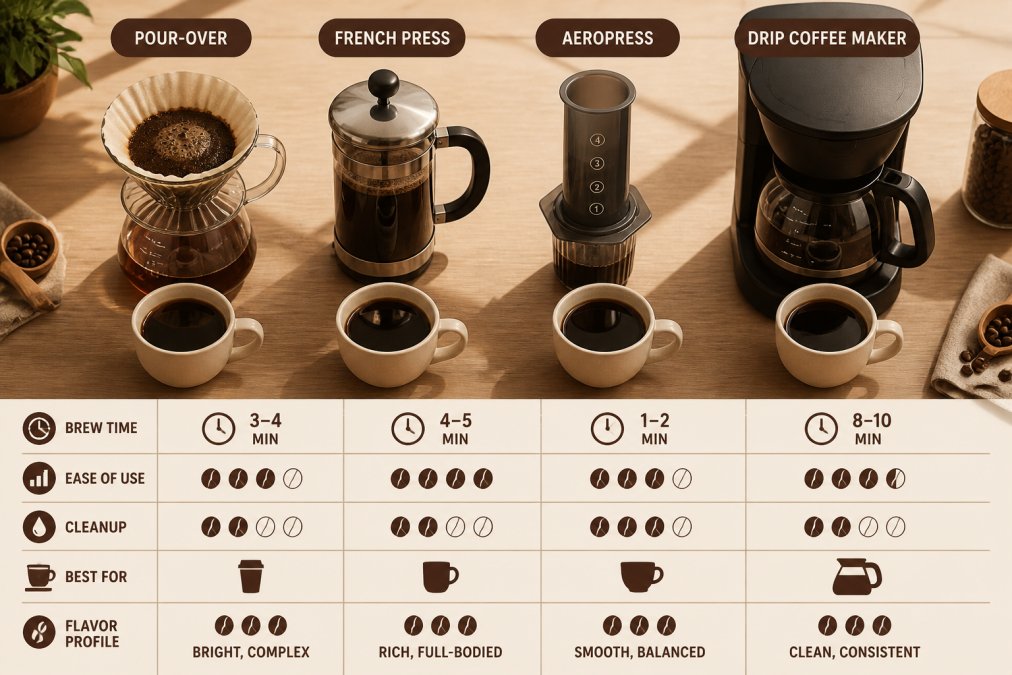
Your choice also carries a sustainability angle that many guides ignore. Paper filters are compostable but single-use, while metal mesh filters last for years with no ongoing waste. If minimizing landfill contribution matters to you, the French press or AeroPress with a reusable filter is the greener pick, at the cost of a little sediment in your cup.
Method 1: Pour-Over for a Clean, Bright Cup
Pour-over brewing is the best coffee brewing method for beginners who want a clean, bright cup without investing in a machine. A gooseneck kettle, a cone dripper, and paper filters cost less than most electric brewers, and the technique is easy to learn.
The process builds flavor through the bloom phase and controlled pour technique. Heat water to around 200°F, just off a full boil (sca.coffee). Place a paper filter in the cone and rinse it with hot water to remove papery taste and warm the vessel. Add ground coffee, then pour twice the coffee's weight in water to saturate the grounds. Wait 30 seconds while the coffee blooms and releases trapped carbon dioxide. Continue pouring in slow circles, keeping the water level below the cone's rim. Total extraction time should land between three and four minutes.
The paper filter is the secret to the method's signature clarity. It traps fine particles and most natural oils, producing a clean cup with pronounced acidity and tasting notes that shine through without muddiness. For those who want to explore single-origin beans, this transparency makes pour-over the best way to taste a coffee's terroir.
Method 2: The French Press for Full-Bodied Flavor
The French press delivers the richest, most forgiving cup of any method here, which makes it a favorite among beginners who value flavor over finesse. Immersion brewing extracts heavily, producing a full-bodied coffee with a velvety mouthfeel and a fine layer of sediment.
Start with a coarse, consistent grind, roughly the texture of sea salt. Add coffee to the empty glass carafe, pour hot water just off the boil over the grounds, and stir gently to ensure full saturation. Place the lid on with the plunger raised and let it steep for four minutes. Press the plunger down slowly and steadily, then pour immediately. Leaving the coffee sitting on the grounds continues extraction and turns bitter.
The metal mesh filter is the defining feature. Unlike paper, it lets natural oils and micro-fines through, which builds body and depth. The trade-off is sediment in the final cup and a heavier mouthfeel that some drinkers find too thick.
Best Coffee Beans for French Press
The best coffee beans for French press are medium to dark roasts with chocolate, nut, or caramel notes, since the method amplifies body and sweetness. A dark French roast blend works exceptionally well here, as does a single origin with molasses or brown sugar characteristics. Look for a coarse grind specifically, because fine grounds slip through the mesh and make the cup gritty and over-extracted. Our Best Sellers Sample Pack at $25.00 includes several roasts suited to immersion brewing, letting you compare profiles before committing to a full bag.
Method 3: AeroPress for Versatility and Speed
The AeroPress is the best coffee brewing method for beginners who want cafe-style variety without collecting multiple devices. It brews a smooth, concentrated cup in about two minutes, and it is nearly indestructible for travel.
The AeroPress uses rapid immersion followed by air pressure to push coffee through a paper micro-filter. This short extraction time produces a cup with low bitterness and acidity, closer to espresso in concentration when used with a fine grind. Its real strength is experimentation. You can adjust grind size, steep time, and dilution to mimic everything from a strong American-style coffee to a cold brew concentrate.
Setup is minimal: place a filter in the cap, rinse it, add finely ground coffee, pour in hot water, stir, and press. Cleanup takes seconds because the spent grounds eject as a single puck. For busy mornings or camping trips, few methods match its speed and portability.
Method 4: Drip Coffee Makers for Hands-Off Convenience
Drip coffee makers are the automatic drip option for beginners who want consistent coffee without standing over a kettle. They automate the pour-over process, heating water and showering it over grounds in a filter basket.
The trade-off is control. Most machines spray water unevenly, and cheaper models struggle with water temperature, which directly affects extraction and flavor. Choosing a machine with a thermal carafe rather than a hot plate avoids the burnt taste that develops from prolonged heating.
For those who want convenience without the machine's limitations, single-serve capsules offer a middle path. Our 12 Pack Single Serve Coffee Capsules at $15.00 use a sealed, oxygen-free capsule that keeps the coffee fresh, and an improved filter design that extracts more grounds for a lively cup without slowing brew time. The 60 Pack at $60.00 brings the cost per cup down for daily drinkers. This delivers the hands-off convenience of a machine while preserving the freshness that stale pre-ground coffee loses.


Essential Coffee Brewing Ratios for Beginners
A consistent coffee-to-water ratio is the single biggest upgrade a beginner can make, more impactful than any equipment change. The standard starting point is 1:16, meaning one gram of coffee for every 16 grams of water (sca.coffee). That produces a balanced cup with moderate strength.
| Desired Strength | Ratio (Coffee:Water) | Example for 12 oz Water |
|---|---|---|
| Light and delicate | 1:17 | 20 grams |
| Balanced standard | 1:16 | 21 grams |
| Strong and bold | 1:14 | 24 grams |
Weighing your coffee and water removes all guesswork. A digital kitchen scale costs about the same as a bag of beans and pays for itself in consistency. If you do not own a scale, use two tablespoons of coffee per six ounces of water as a rough starting point, then adjust to taste.
Water quality matters just as much. Filtered water, rather than tap water heavy with minerals or chlorine, lets the coffee's tasting notes surface. The Specialty Coffee Association publishes guidance on water standards for brewing, and the association's brewing resources confirm that water composition directly affects extraction quality.
A Simple Coffee Grind Size Chart for Beginners
Grind size controls how quickly water extracts flavor from the grounds, so matching it to your brew time is essential. The longer the water touches the coffee, the coarser the grind should be, preventing bitterness from over-extraction.
| Brew Method | Grind Size | Texture Reference | Typical Brew Time |
|---|---|---|---|
| French press | Coarse | Sea salt | 4 minutes |
| Pour-over | Medium | Sand | 3-4 minutes |
| AeroPress | Fine | Table salt | 1-2 minutes |
| Drip maker | Medium | Sand | 5-8 minutes |
Freshly roasted beans ground just before brewing make the largest flavor difference available to a home brewer. Ground coffee loses volatile aromatics quickly, and pre-ground bags from the supermarket are often stale before they reach your kitchen. Buying whole beans and grinding only what you need preserves the tasting notes that roasters work to develop.
For a beginner, the fastest route to better coffee is pairing freshly roasted beans with the right grind. Our Instant Coffee at $19.99 offers a resealable pouch with 30 servings for mornings when even a grinder feels like too much, while our whole-bean blends and single origins reward the extra minute of grinding with noticeably richer flavor.

Choosing your first brewing method comes down to honesty about your routine: how much time you will actually spend, what flavors you already enjoy, and how much cleanup you will tolerate. Each method above produces excellent coffee when paired with freshly roasted beans and a grind size that matches its brew time. Hall's Coffee & Tea ships premium, carefully sourced beans and blends free across the US, with secure payment and oxygen-free packaging that keeps coffee fresh from our roaster to your door. Shop coffee and find the method that turns your morning into a moment worth pausing for.
Frequently Asked Questions
What is the easiest coffee brewing method for a beginner?
The easiest method is often an automatic drip coffee maker because it handles water temperature and timing for you. You just add coffee grounds and water, press start, and wait. For a more hands-on option, the French press is also forgiving since it doesn't require a precise pouring technique. Start with quality pre-ground coffee or buy a burr grinder to improve flavor quickly.
What is the best coffee to water ratio for beginners?
A standard coffee brewing ratio for beginners is 1:16, meaning one part coffee to sixteen parts water. For most brewers, that translates to about 2 tablespoons of ground coffee per 6 ounces of water. Start there and adjust to taste. Use more coffee for a stronger brew or more water for a milder cup.
How does grind size affect different brewing methods?
Grind size controls how quickly water extracts flavor from the grounds. A coarse grind works best for the French press because it steeps for several minutes. A medium grind suits drip makers, and a fine grind is needed for AeroPress or pour-over. Too fine a grind for a long steep results in a bitter, over-extracted cup.
What type of coffee beans should I buy for a French press?
Look for beans roasted for full immersion brewing. A dark or medium-dark roast with tasting notes like chocolate or caramel works well. Coarse ground coffee is essential to prevent sediment. Start with a sample pack to find flavors you enjoy before committing to a full bag.
What is the 15-15-15 rule for coffee?
The 15-15-15 rule is a simple guide for French press brewing: use 15 grams of coffee per 250 milliliters of water, steep for 15 minutes, and use a 15:1 coffee-to-water ratio. This method produces a very strong cup. Beginners may prefer a shorter steep time of 4 minutes for a smoother flavor.
This article was written using GrandRanker
