

Is a Burr Grinder Worth It for Home Brewing? 2026 Guide
Table of Contents
- What a Burr Grinder Actually Changes in Your Cup
- Blade vs Burr Grinder Taste Test: What You'll Notice
- Does Grind Size Affect Coffee Extraction?
- Matching Grind Settings to Your Brew Method
- Best Entry Level Burr Grinders: What to Look For
- The Costs Nobody Mentions: Cleaning, Noise, and Counter Space
- Entry-Level vs Prosumer: Where Your Money Actually Goes
- Frequently Asked Questions
Last Updated: September 24, 2026
What a Burr Grinder Actually Changes in Your Cup
A burr grinder is a coffee grinder that crushes beans between two rotating abrasive surfaces, producing grounds of a consistent size rather than the random mix a spinning blade creates. That single mechanical difference, consistent particle size, is what separates a flat, muddy cup from one with clear flavor. If you have ever wondered "is a burr grinder worth it for home brewing," the honest answer is that it is the highest-impact upgrade most home setups can make, ahead of a new brewer or a different bean. This guide from Hall's Coffee & Tea breaks down what changes in the cup, what it costs, and where the money actually goes.
The reason comes down to water.
Blade vs Burr Grinder Taste Test: What You'll Notice
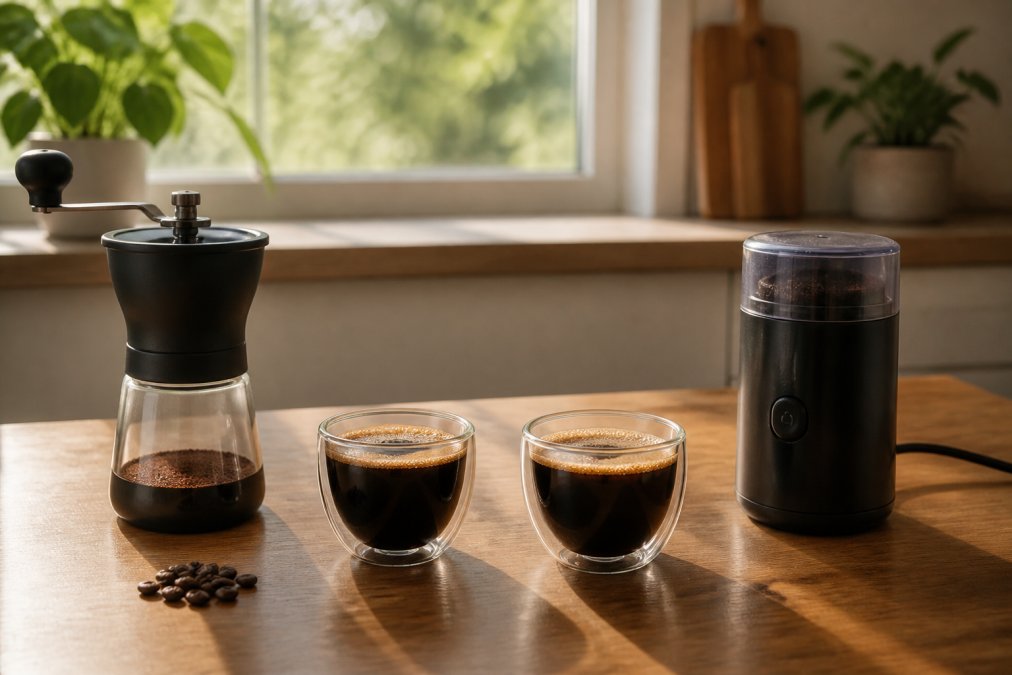
The clearest way to understand the difference is to taste it yourself. A blade grinder chops beans into a mix of fine dust and coarse chunks. A burr grinder produces particles that are close to the same size.
How to Run a Fair Side-by-Side Test at Home
- Use the same beans, same weight, and same water temperature for both cups
- Grind one batch with a blade grinder, one with a burr grinder
- Brew both with the same method, such as a pour-over or French press
- Taste them blind, without knowing which is which
- Note bitterness, acidity, body, and sweetness separately
The differences show up most in lighter roasts and single-origin beans, where flavor clarity is the whole point.
Does Grind Size Affect Coffee Extraction?
Grind size directly controls extraction rate, which is how much flavor the water pulls from the grounds. Finer grounds expose more surface area and extract faster. Coarser grounds extract slower.
Matching Grind Settings to Your Brew Method
Each brew method needs a different grind size. Getting this right is where a burr grinder earns its keep.
| Brew Method | Grind Size | Typical Brew Time |
|---|---|---|
| French press | Coarse | 4 minutes |
| Drip coffee | Medium | 4-6 minutes |
| Pour-over | Medium-fine | 2-3 minutes |
| Espresso | Fine | 25-30 seconds |
Best Entry Level Burr Grinders: What to Look For
Entry-level burr grinders span a wide range, and the "worth it" answer changes depending on how much you spend. Breaking the market into budget tiers makes the decision clearer than any single recommendation.
What Actually Matters at Each Tier
- Burr material and geometry. Ceramic burrs hold an edge well and resist heat; steel burrs cut faster and are common in espresso-focused grinders. Both beat blade grinding by a wide margin.
- Adjustment type. Stepped grinders click into fixed positions, which is easier for beginners and fine for filter methods. Stepless grinders let you nudge grind size in tiny increments, which espresso calibration requires.
- Retention. How much ground coffee stays inside the machine between doses. High retention means your next dose is partly stale grounds. Hand grinders and well-designed single-dose electrics keep retention low.
- Static and mess. Cheaper grinders often throw grounds and cling to the catch cup. A drop of water on the beans or a grounded catch cup reduces this.
- Motor torque. Weak motors stall on dense, light-roasted beans. If you brew light roasts, torque matters more than burr size.
Conical vs Flat Burrs at the Entry Level
Most entry-level grinders use conical burrs, shaped like a cone and turning slowly. They tend to run quieter, cost less, and produce a particle distribution that works well across filter methods. Flat burrs produce a more uniform grind and are common in higher-end and espresso-focused machines, but they usually cost more and demand more from the motor.
The Costs Nobody Mentions: Cleaning, Noise, and Counter Space
The purchase price is only part of the picture. The ongoing costs of ownership, cleaning time, noise, and counter footprint, are what most buying guides skip, and they are often what determines whether a grinder actually gets used every morning.
Cleaning: The Real Maintenance Schedule
Coffee oils build up on burrs and in the grind chamber over time. Left alone, those oils go rancid and transfer a stale, cardboard-like taste into every subsequent cup, no matter how fresh the beans are.
A workable cadence for most home brewers:
- Daily or every few days: brush out the grind chamber and catch cup. A stiff-bristle brush or the brush that ships with most grinders takes under a minute.
- Weekly: run a small amount of uncooked white rice or a dedicated grinder cleaning tablet through the burrs, then brush out the residue. This lifts oils the brush alone misses.
- Monthly to quarterly: disassemble the burr set per the manufacturer's instructions and clean the burrs and threads thoroughly. Hand grinders are usually tool-free; many electric grinders require a screwdriver.
- Annually or per manufacturer guidance: inspect burrs for wear. Dull burrs produce more fines and a wider particle distribution, which shows up as inconsistent extraction.
Noise: What to Expect in Decibels
Noise is a real consideration for anyone brewing before the rest of the household wakes up. Rough general ranges:
- Hand grinders: roughly 50 to 60 dB, comparable to a quiet conversation. Nearly silent in practice.
- Electric burr grinders: roughly 70 to 90 dB, comparable to a blender or a vacuum cleaner, depending on motor and burr type.
- Blade grinders: often 90 dB or higher, and the sound is a high-pitched whine rather than a steady hum.
Counter Space and Footprint
Counter space is the constraint that quietly kills grinder usage. If a grinder is awkward to pull out and set up, it stops getting used.
- Hand grinders: roughly the size of a large travel mug. Store in a drawer or cabinet. Effectively zero counter footprint.
- Compact electric conical grinders: roughly the footprint of a small coffee maker, often 4 to 6 inches wide. Fits under most upper cabinets.
- Full-size flat burr and prosumer grinders: often 6 to 10 inches wide and 15 inches or more tall, sometimes too tall to fit under standard upper cabinets. These are best treated as permanent counter fixtures.
Entry-Level vs Prosumer: Where Your Money Actually Goes
For a starting point, Hall's Coffee & Tea offers a curated range of single-origin beans, including Bali Blue with its dark chocolate and molasses notes, and Ethiopia Natural with milk chocolate and caramel. Fresh beans and a consistent grind are the two halves of a better cup.


Frequently Asked Questions
What is the main difference between a blade and a burr grinder?
A blade grinder spins a metal blade that chops beans into uneven pieces, producing a mix of fine dust and coarse chunks. A burr grinder crushes beans between two abrasive surfaces set a fixed distance apart, so every particle comes out close to the same size. That uniformity is what lets you repeat a good cup instead of getting a different result every morning.
Does a burr grinder really make coffee taste better?
It makes coffee taste more consistent and more like the roaster intended. Uneven grounds extract at different rates, so fine particles over-extract into bitterness while coarse ones under-extract and leave the cup thin. With uniform grounds, a medium roast like Hall's Coffee & Tea Colombia ($18.99) shows its dried orange, berry, and chocolate notes instead of a muddy, bitter edge.
Is a burr grinder worth it for a basic drip coffee maker?
Yes, if you buy whole beans. Drip brewers are forgiving, but they still reward even extraction. A burr grinder set to a medium grind keeps the bed of coffee uniform, which means the water passes through at a steady rate. You do not need an expensive model for drip; an entry-level burr grinder is enough to notice the difference.
Do I need a burr grinder for French press coffee?
French press is where grind consistency matters most, because a coarse, even grind keeps the plunger moving freely and limits the sludge that slips through the mesh. A blade grinder's fine dust passes straight through the filter and keeps extracting in the carafe, turning the cup bitter as it sits. A burr grinder set coarse fixes that.
Are manual burr grinders as good as electric ones?
For most home brewing, yes. Manual burr grinders use the same conical burr mechanism as electric models and often give you finer control over grind size. The trade-off is effort and time: grinding 30 grams for a French press by hand takes a couple of minutes. Electric models cost more but remove that step from your morning routine.
If your coffee tastes inconsistent from one morning to the next, the grinder is usually the reason. A burr grinder gives you the control to fix that, and Hall's Coffee & Tea gives you beans worth grinding. With free US shipping, secure payments, and expertly crafted single-origin selections delivered to your door, we make it easy to pair a better grind with better coffee. Get started with Hall's Coffee & Tea and taste the difference a consistent grind makes.
