

Understanding Coffee Bean Roast Levels: A 2026 Guide
Table of Contents
- What Coffee Bean Roast Levels Actually Mean
- Light, Medium, and Dark Roast Characteristics Compared
- Light vs Dark Roast Caffeine Content: What the Scale Really Shows
- Roast Level Terminology: City, Full City, Vienna, French, and Italian
- How to Identify Roast Level by Sight, Smell, and Touch
- Best Coffee Beans for Home Brewing: Matching Roast Level to Your Method
- How to Store Coffee Beans for Freshness
- Frequently Asked Questions
Last Updated: September 10, 2026
What Coffee Bean Roast Levels Actually Mean
Coffee bean roast levels describe how far a roaster has taken a green coffee bean through heat, the biggest factor you control after origin. This guide from Hall's Coffee & Tea breaks down what each level tastes like, how to spot it by sight, and which beans suit your brewer.
Green coffee smells grassy and tastes vegetal. Heat triggers the Maillard reaction and caramelization, transforming sugars and acids into coffee flavor. The longer and hotter the roast, the more origin characteristics fade and roast-driven flavors take over.
That's the core tension in every bag: roast degree trades origin clarity for developed, darker flavor. Neither is better, they're different tools.
First Crack and Second Crack: The Roaster's Signal
Roasters don't measure roast level in minutes. They listen for two audible signals.
First crack is the popping of moisture escaping the expanding bean, marking the start of a light roast. Second crack is a softer, faster crackling as bean structure breaks down, pushing into dark roast territory.
Pull the beans just after first crack and you get a light roast. Let them run toward second crack and you're heading dark. Stop before first crack and the beans are underdeveloped, sour and grassy.
Light, Medium, and Dark Roast Characteristics Compared
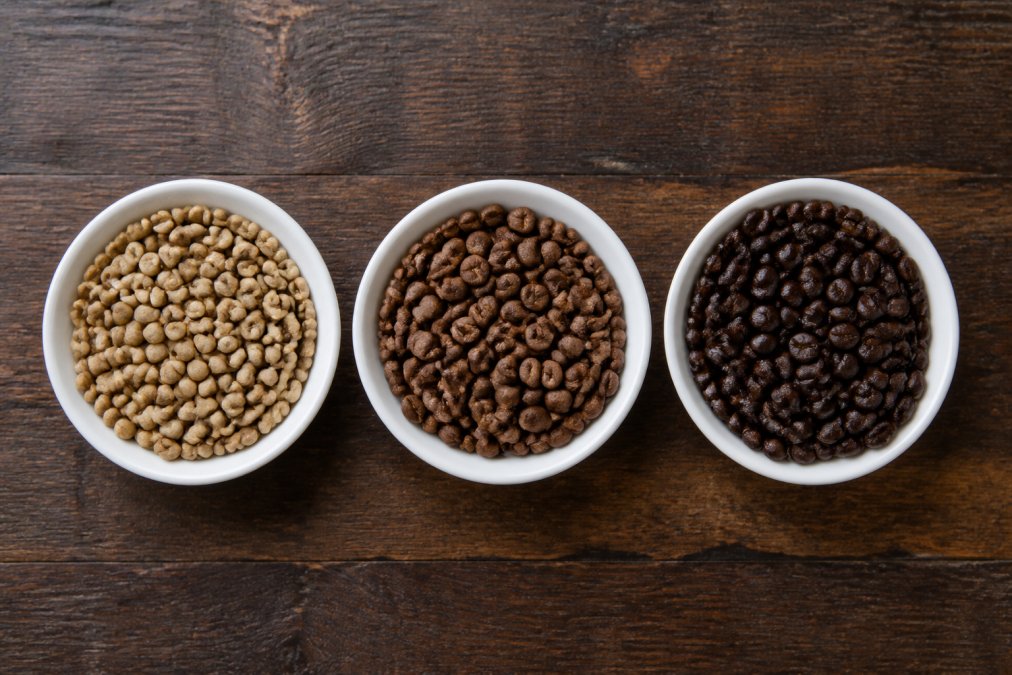
Each roast level delivers a distinct flavor profile, and matching it to your taste matters more than any label. Light roasts preserve acidity and origin character; dark roasts build body and bittersweet depth.
| Roast Level | Color | Flavor Profile | Acidity | Body | Best For |
|---|---|---|---|---|---|
| Light | Pale tan, dry surface | Fruity, floral, bright | High | Light | Pour-over, drip |
| Medium | Medium brown, no oil | Balanced, caramel, nutty | Medium | Medium | Drip, AeroPress |
| Dark | Dark brown, oily | Bittersweet, smoky, bold | Low | Full | Espresso, French press |
Light Roast
Light roasts stop around first crack, keeping bean density high and surface dry. You taste the origin: berry, citrus, floral notes. The trade-off: light roasts punish sloppy brewing and turn sour if under-extracted.
Medium Roast
Medium roasts balance acidity and body, which is why they're the most forgiving for home brewing. Caramel and nutty notes dominate. Our Specialty Coffee Association flavor wheel groups these as the most approachable everyday profile.
Dark Roast
Dark roasts run past second crack, pulling oils to the surface and muting origin characteristics. Expect bittersweet chocolate, smoke, and low acidity. The National Coffee Association's brewing guidance notes dark roasts extract faster, so shorten your brew time slightly.
Light vs Dark Roast Caffeine Content: What the Scale Really Shows
The light vs dark roast caffeine content debate has a counterintuitive answer: dark roast does not automatically contain more caffeine. By weight, light roasts often edge ahead because denser beans pack more mass per scoop.
Roasting burns off mass, not caffeine. A dark roast bean is lighter and larger than its light roast twin, so a scoop holds fewer beans. Measure by weight and the gap nearly vanishes; by volume, light roast usually wins.
Caffeine depends far more on species (Arabica vs Robusta), altitude, and dose than roast degree. If caffeine is your priority, buy a Robusta blend rather than chasing the darkest roast on the shelf.
Roast Level Terminology: City, Full City, Vienna, French, and Italian
Traditional roast names describe points on the same spectrum, but the industry has no binding standard for what each name means, the single most confusing thing about buying coffee, and most guides skip it.
The Traditional Spectrum
Cinnamon roast is the lightest, stopped before first crack finishes. City roast is a classic light-medium. Full City sits at medium-dark, just before second crack. Vienna roast lands mid-second-crack, dark but not charred. French roast runs deeper, oily and smoky. Italian roast is the darkest common style, used for espresso.

| Term | Roast Degree | Typical Bean Color | Surface Oil | Common Use |
|---|---|---|---|---|
| Cinnamon | Very light | Pale tan | None | Rarely sold; cupping labs |
| City | Light-medium | Light brown | None | Drip, pour-over |
| Full City | Medium-dark | Medium brown | Trace | Drip, AeroPress |
| Vienna | Dark | Dark brown | Light sheen | Espresso, French press |
| French | Very dark | Very dark brown | Oily | Espresso, dark-roast drinkers |
| Italian | Darkest | Near-black | Heavily oily | Espresso blends |
Why "Medium" Means Different Things at Different Roasters
Here's the problem the table can't solve: roast names aren't regulated in the US. The FDA oversees coffee as a food product but doesn't define roast levels, and USDA grading applies to green coffee, not roasted (the FDA). The Specialty Coffee Association publishes an Agtron-scale roast color classification, but adoption is voluntary and most retail bags don't print an Agtron number.
The practical result: one roaster's "Medium" can be another's "Medium-Dark," and a third's "Full City" can land where the first puts "Vienna." A small-batch "French roast" may be lighter than a mass-market "Medium."
How to Navigate It as a Buyer
Since labels won't save you, use these signals instead:
- Agtron number, if printed. Lower numbers mean darker. Roughly: 95-85 is light, 85-65 is medium, 65-45 is medium-dark, below 45 is dark. Few bags show this, but specialty roasters increasingly do.
- Bean color. Hold a bean to natural light. Pale tan and matte means light. Medium brown with no shine means medium. Dark brown with visible oil means dark.
- Surface oil. Oil on the bean means the roast went past second crack. No oil means it didn't.
- Roaster's tasting notes. If the notes say "smoky," "bittersweet," or "dark chocolate," treat it as dark regardless of the label. If they say "floral," "citrus," or "berry," treat it as light.
- Roast date, not just "best by." Dark roasts stale faster (see the storage section below), so a fresh dark roast beats an old light roast every time.
A Practical Buying Rule
When you switch roasters, buy the same roast level you usually drink and compare it side by side with your old bag before committing to a larger order. Two bags of "medium" from two roasters can taste like two different coffees. Once a roaster's "medium" matches your preference, that terminology becomes your baseline for translating every other roaster's labels.
How to Identify Roast Level by Sight, Smell, and Touch
You can identify roast level without a label using three senses: sight for color and surface oil, smell for development, touch for density and texture.
- Sight: Pale and dry means light. Medium brown with no oil means medium. Dark and shiny means dark.
- Smell: Fruity and floral signals light. Caramel and nuts signal medium. Smoke and cocoa signal dark.
- Touch: Light beans feel dense and hard. Dark beans feel lighter and crumble more easily.
Bean volume grows as roast darkens while mass shrinks, which is why the same weight of dark roast fills more of your grinder.
Best Coffee Beans for Home Brewing: Matching Roast Level to Your Method
The best coffee beans for home brewing depend on your equipment, not on which roast is objectively superior. Brewing method compatibility is the angle most guides skip: the same bean that sings in a pour-over can taste hollow in a French press, because each device extracts differently.
Why the Match Matters: Extraction Mechanics
Every brewer varies along three axes, contact time, water temperature, and surface access. Light roasts are denser, less soluble, and hold acids tightly, so they need more work to extract fully. Dark roasts are porous, oilier, and highly soluble, giving up compounds fast and tipping into bitterness if pushed.
That principle explains every pairing below: gentle, fast brewers suit easy-extracting roasts; aggressive, slow brewers suit roasts that resist over-extraction.
Roast-to-Brewer Compatibility Matrix
| Brewer | Ideal Roast | Grind | Water Temp | Ratio (coffee:water) | Why It Works |
|---|---|---|---|---|---|
| Pour-over (V60, Chemex) | Light to medium-light | Medium-fine | 195-205°F | 1:15 to 1:16 | Paper filters trap oils; bright acids and origin clarity come through |
| Automatic drip | Medium | Medium | 195-205°F | 1:16 to 1:17 | Forgiving extraction window suits balanced caramel/nut notes |
| AeroPress | Medium | Medium-fine | 175-200°F | 1:12 to 1:15 | Adjustable time and pressure handle either direction |
| French press | Medium to dark | Coarse | 195-205°F | 1:12 to 1:15 | Full immersion and metal mesh favor body and low acidity |
| Moka pot | Medium-dark to dark | Fine | ~200°F (steam-driven) | 1:10 to 1:12 | High pressure and heat need developed, soluble sugars |
| Espresso | Medium-dark to dark | Fine | 195-205°F | 1:2 (in to out) | 9 bars of pressure extracts fast; dark roasts resist bitterness |
| Cold brew | Medium to dark | Coarse | Room temp / cold | 1:5 to 1:8 (concentrate) | Long steep needs low-acid, high-body beans to avoid sourness |
Reading the Matrix in Practice
Drink pour-over and want a farm's terroir? Buy light. Drink French press and want the cup to match the bag's aroma? Buy medium-dark. Drink espresso and want a shot that doesn't turn to ash? Buy medium-dark to dark, but not so dark the oils have gone rancid.
Many home brewers buy one bag per brewer rather than one for the whole kitchen. A medium-light Ethiopian for the V60 and a medium-dark Brazilian for the French press will outperform a single "compromise" medium roast in both devices.

If you want a starting point, our Ethiopia Natural is a medium-light single origin with milk chocolate and caramel notes that suits pour-over beautifully. For espresso drinkers, the Italian Roast delivers the darkest, boldest profile in our lineup.

How to Store Coffee Beans for Freshness
Knowing how to store coffee beans for freshness comes down to three enemies: oxygen, moisture, and heat. Roast level changes how fast they win.
Dark roasts have more surface oil and porous structure, so they oxidize faster. A dark roast can taste stale within two weeks of opening; a light roast may hold character for four. Buy quantities you'll finish within that window.
- Store beans whole in an opaque, airtight container
- Keep the container in a cool, dark cabinet, not the fridge
- Avoid the freezer unless you're storing a sealed bag long-term
- Grind immediately before brewing
Freezing works if you portion beans into sealed bags and never thaw and refreeze. Done carelessly, it introduces moisture and ruins the batch.
Roast level is the dial that decides whether you taste the farm or the fire. Get it wrong and even excellent beans disappoint. Hall's Coffee & Tea roasts to order and ships free, so your beans arrive fresh rather than sitting on a shelf. Explore our single-origin selections, including the Tanzania with its pear and jasmine notes, or try the Coffee with Mushrooms Medium Roast for a balanced everyday cup. Get started with Hall's Coffee & Tea and taste the difference roast level makes.
Frequently Asked Questions
Which coffee roast level is best for home brewing?
There's no single best roast level, but your brewing method narrows the choice. Light and medium roasts suit pour-over and drip because their acidity and fruit notes survive paper filtration. Dark roasts work well in espresso and French press, where their body and chocolate notes come through. If you drink coffee with milk or cream, a medium or dark roast holds up better. Start with a medium roast, then adjust based on whether you want more brightness or more depth.
How does roast level affect caffeine content in coffee?
Roast level changes caffeine far less than most people expect. Caffeine is stable during roasting, so a light and dark roast from the same green coffee start with nearly identical caffeine. What shifts is density: dark-roasted beans lose more mass and volume, so a scoop of dark roast weighs less than a scoop of light roast. Measure by weight, not volume, and you'll get consistent caffeine regardless of roast. A standard 10-gram dose delivers roughly 95-100 milligrams either way.
What are the four main types of coffee roasts?
Most roasters group beans into four broad categories: light, medium, medium-dark, and dark. Light roasts stop shortly after first crack and keep the bean's origin characteristics, like floral and fruity notes. Medium roasts balance acidity and body with caramel sweetness. Medium-dark roasts develop oil on the surface and deeper chocolate notes. Dark roasts, including French and Italian styles, run past second crack and taste smoky and bittersweet. Many bags use names like City or Full City, which map onto these four groups.
Does a darker roast mean a stronger coffee flavor?
Not in the way most people assume. Dark roasts taste bolder and more bitter, but they actually mute the bean's origin characteristics. A dark-roasted Ethiopian bean loses the jasmine and berry notes that define it, replaced by smoke and dark chocolate from the roast itself. Light roasts carry more perceived acidity and complexity. If you want the fullest expression of where a coffee came from, choose a light or medium roast. If you want roast-driven flavor, go dark.
Which roast level works best for pour-over brewing?
Light and medium roasts are the standard pick for pour-over. Their acidity and delicate flavor notes survive the paper filter, which strips some oils and body. A medium-light single-origin bean, like an Ethiopian natural, gives you fruit and caramel notes that a dark roast would bury. Dark roasts can work in pour-over if you enjoy a heavier cup, but grind slightly coarser and lower your water temperature to about 195°F to avoid extracting too much bitterness.
How should I store coffee beans to keep them fresh?
Keep beans in an opaque, airtight container at room temperature, away from light, heat, and moisture. A one-way valve bag works well if you squeeze out excess air. Buy in quantities you'll finish within two to four weeks of the roast date. For longer storage, freeze beans in a sealed bag and grind from frozen without thawing. Avoid the fridge: its humidity and food odors degrade flavor fast. Whole beans stay fresh longer than ground coffee.
What is the 15-15-15 rule for coffee?
The 15-15-15 rule is a pour-over guideline: use a 1:15 coffee-to-water ratio, wait 15 seconds after the bloom pour, and finish the brew in about 15 minutes total including setup. It's a memory aid, not an industry standard, and many baristas adjust the ratio between 1:15 and 1:17 depending on roast level. Light roasts often need a finer grind and a slightly longer brew to extract their flavors fully, while dark roasts extract faster and prefer coarser grounds.
